Should You Train Outside During a Heatwave? Here’s What I Told My Client This Week

Strength vs Hypertrophy Training: How to Build Muscle, Strength and Power

This week, London was hot.

Really hot.

One of my clients arrived for their session already feeling drained. They’d walked to the gym in the heat, hadn’t drunk enough water, and said something I hear every summer.

“I don’t think I’ve got much in me today.”

Most people think that means they should skip training.

I saw it differently.

We adjusted the session.

We reduced the rest periods slightly, kept the intensity under control, focused on quality movement instead of chasing personal bests, and made hydration part of the workout.

By the end of the session, they felt stronger, energised and glad they had turned up.

That session reminded me of something I tell all my clients.

The weather should change how you train, not whether you train.

Strength vs Hypertrophy Training: How to Build Muscle, Strength and Power

The mistake people make during hot weather

Every summer I see the same pattern.

People either:

  • Train as hard as they normally would and wonder why they feel exhausted.
  • Skip the gym completely because it’s too hot.

Neither is the answer.

Your body is working harder in warm conditions.

Your heart has to pump more blood to your skin to cool you down.

You sweat more.

You lose fluids.

That means the same workout you’ve done for months can suddenly feel much harder.

It doesn’t mean you’re getting less fit.

It means your body is adapting to the environment.

12REPS: Your Pocket Personal Trainer for 2026 - The Best Strength Training App for Men, Women, and PTs

Should you train outdoors?

Absolutely.

I love training outdoors.

Something is refreshing about fresh air, natural light and getting away from four walls.

If you’re going to train outside during a heatwave, be smart.

I recommend:

  • Training before 9am or later in the evening.
  • Choosing shaded routes where possible.
  • Drinking water throughout the day, not just during your workout.
  • Reducing the intensity if your heart rate feels unusually high.

One slower run or lighter workout won’t ruin your progress.

Missing weeks of training because you’ve pushed too hard might.

When I prefer my clients to train indoors

There are days when the gym is the better option.

If you’re planning:

  • Heavy squats or deadlifts.
  • A long strength workout.
  • High-intensity circuits.
  • Progressive overload.

A cooler environment allows you to focus on movement quality instead of simply trying to stay cool.

You’ll often recover better and perform better.

40 Best Strength Exercises for Men Over 30 Who Want to Get in Shape

Don’t chase numbers every session

One of the biggest lessons I’ve learned after years of coaching is this.

Your body doesn’t know what the number says on the bar.

It only knows the stress you’re placing on it.

During a heatwave, that stress is already higher.

Sometimes the smartest session is:

  • Using slightly lighter weights.
  • Taking an extra minute between sets.
  • Finishing 10 minutes earlier.
  • Leaving the gym feeling like you could have done one more set.

That’s not weakness.

That’s intelligent training.

Hydration starts before your workout

One mistake I see all the time is people trying to catch up on water once they arrive at the gym.

By then, you’re already behind.

Drink regularly throughout the day.

If you’ve had a long day in the office or travelled in the heat, spend a few minutes rehydrating before you start your session.

Small habits make a big difference.

Consistency always beats perfection

The people who stay fit for years aren’t the ones who train the hardest.

They’re the ones who adapt.

Some days you’ll train outside.

Some days the gym will be the better choice.

Some days you’ll reduce the weight or shorten the workout.

That’s not losing momentum.

That’s how you keep momentum.

As I told my client this week:

“The goal today isn’t to break records. The goal is to keep showing up.”

Those small decisions are what build strength, improve your health and keep you progressing for years, not just through one summer.

If you have a structured plan, it’s much easier to make those adjustments without losing direction.

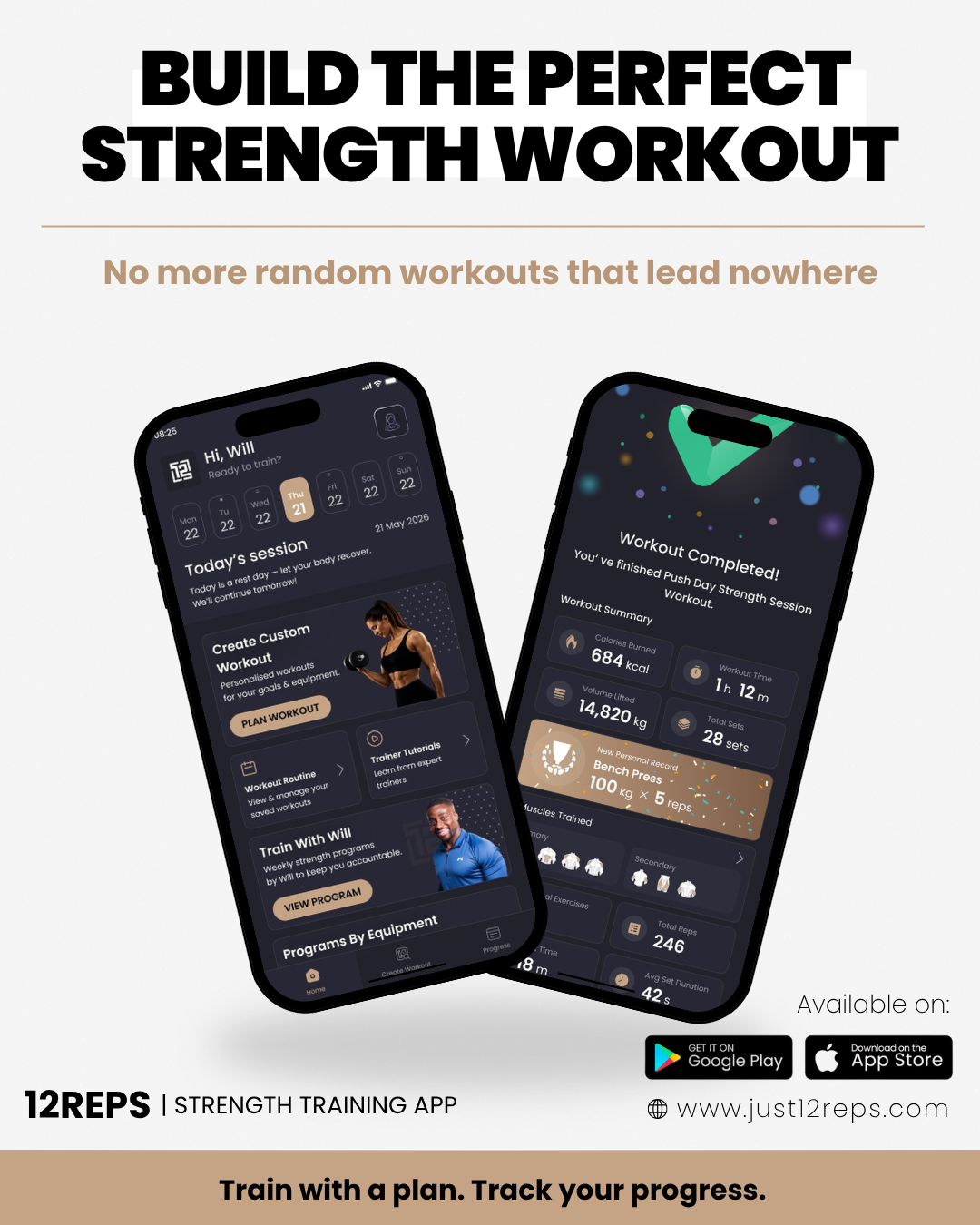
That’s exactly why I built 12REPS.

Whether you’re training at home, in the gym or outside, your programme is already planned. You know what to do, you can adjust the intensity when needed, and you can track every workout as you build long-term consistency.

Stay hydrated.

Train smart.

Keep showing up.

PT Will Duru
Founder of 12REPS
BSc (Hons) Sport & Exercise Science
How to Lose 5kg of Body Fat

12REPS: Your Pocket Personal Trainer for 2026 - The Best Strength Training App for Men, Women, and PTs

You Do Not Need a Spring Detox

Every spring, people decide they need to lose 5kg quickly. They cut out carbohydrates, train every day and try to survive on meals they do not enjoy.

The scale may fall for a few days. Much of that early change can come from water, stored carbohydrate and less food in the digestive system. That is not the same as losing 5kg of body fat.

Fat loss takes a consistent calorie deficit. Keeping muscle while you lose weight also requires protein, strength training and enough recovery to keep performing.

The goal is not to suffer for a month. The goal is to build a routine you can follow until the result arrives, then keep using after it does.

What Losing 5kg of Body Fat Really Requires

  • A moderate calorie deficit you can maintain without constant hunger.
  • Enough protein to support muscle retention and recovery.
  • Strength training that gives your body a reason to keep muscle.
  • Daily movement that increases energy expenditure without exhausting you.
  • Sleep and recovery that help you control your appetite and train well.
  • Several weeks or months of consistency, depending on your starting point.

The Five-Part Fat-Loss Plan I Give My Clients

1. Create a Moderate Calorie Deficit

Start by reducing your average food intake slightly, not dramatically. A smaller deficit is easier to repeat and gives you more energy for training, work and family life.

  • Keep regular meal times where possible.
  • Reduce portions of calorie-dense foods before removing whole food groups.
  • Measure oils, sauces, snacks and drinks for one or two weeks if progress has stalled.
  • Review your weekly average weight rather than reacting to one morning.

2. Build Every Meal Around Protein

Protein helps meals feel more filling and supports muscle while you lose weight. Choose an amount that suits your body size and diet, then spread it across the day.

  • Eggs, Greek yoghurt or cottage cheese
  • Chicken, turkey, lean meat or fish
  • Tofu, tempeh, beans or lentils
  • A protein shake when a normal meal is not practical
Building Muscle After 40: What Actually Works (From a Trainer Who's Seen It Done)

3. Strength Train Two to Four Times Each Week

Cardio can help create a calorie deficit. Strength training protects the part of your body you do not want to lose: muscle.

Your sessions should include a squat or lunge, a hip hinge, a push, a pull and core work. Record the weights and repetitions so your training stays productive while body weight falls.

4. Increase Daily Movement

You do not need to turn every workout into high-intensity intervals. Walking is easier to recover from and can make a meaningful difference when repeated every day.

  • Set a step target based on your current average, then increase it gradually.
  • Take a short walk after meals.
  • Use stairs when practical.
  • Walk during calls or your lunch break.

5. Review Progress Every Two Weeks

Look at the trend, not one measurement. Use body weight, waist measurement, progress photos, clothing fit and gym performance together.

When nothing changes for two or three weeks, adjust one variable. Reduce food slightly or add some movement. Do not change everything at once.

How Fast Should You Try to Lose 5kg?

There is no honest fixed deadline that suits every person. Your starting body weight, current body-fat level, training history, food intake, sleep and daily movement all matter.

A slower rate often makes it easier to train well, manage hunger and keep the result. Someone with more weight to lose may see faster early changes. A leaner person may need a longer, more patient approach.

A Practical Weekly Structure

Day

Training

Movement

Main goal

Monday

Full-body strength

Normal step target

Build and retain muscle

Tuesday

Rest or easy cardio

Add a short walk

Increase movement

Wednesday

Full-body strength

Normal step target

Progress key lifts

Thursday

Rest or mobility

Add a short walk

Recover and stay active

Friday

Full-body strength

Normal step target

Train the whole body

Saturday

Optional cardio or activity

Longer walk

Enjoyable movement

Sunday

Rest

Light movement

Prepare for next week

What Changes When You Follow a Plan Instead of Dieting Harder?

  • You stop restarting every Monday.
  • You know what to eat without making every meal perfect.
  • Your gym performance gives you another measure of progress.
  • You can adjust the plan when work, travel or family life changes.
  • You build habits that still make sense after the 5kg is gone.

20 Strength, Bodyweight and Cable Exercises From the 12REPS Library

Each exercise name below links to a live 12REPS exercise guide. The sets and repetitions are starting points for a balanced fat-loss strength programme.

Exercise

Main focus

Sets

Recommended reps

Use in a fat-loss plan

Bodyweight Press-Up

Chest, triceps and core

3

8-15

Upper-body push

Seated Cable Chest Press

Chest and triceps

3-4

8-12

Main pressing exercise

Cable Chest Fly

Chest

3

10-15

Chest accessory

Cable Machine Lat Pulldown

Back and biceps

3-4

8-12

Vertical pull

Cable Machine Wide-Bar Back Row

Mid-back

3-4

8-12

Horizontal pull

Cable Rope Bent-Over Row

Back and rear shoulders

3

10-15

Back accessory

Cable Seated Face Pull

Rear shoulders and upper back

3

12-20

Shoulder balance

Cable Straight-Bar Biceps Curl

Biceps

3

10-15

Arm accessory

Bodyweight Reverse Lunge

Legs and glutes

3

8-12 each leg

Beginner single-leg strength

Bodyweight Bulgarian Split Squat

Quadriceps and glutes

3

8-12 each leg

Single-leg progression

Bodyweight Jump Squat

Lower-body power

3

5-10

Power or conditioning

Single-Leg Box Squat

Leg strength and control

3

6-10 each leg

Advanced single-leg work

Cable Straight-Bar Romanian Deadlift

Hamstrings and glutes

3-4

8-12

Hip hinge

Cable Step-Up

Glutes and quadriceps

3

8-12 each leg

Loaded single-leg work

Bodyweight Hip Thrust

Glutes

3-4

10-20

Glute strength

Cable Glute Kickback

Glutes

3

12-20 each leg

Glute accessory

Frog Pumps

Glutes

2-3

20-30

High-rep finisher

BOSU Ball Glute Bridge

Glutes and core

3

10-15

Glute and stability work

Hanging Leg Raise

Abdominals and hip flexors

3

8-15

Core strength

Hanging Knee Tuck

Abdominals

3

8-15

Core progression

A Simple Three-Day Fat-Loss Strength Plan

Workout One

  • Bodyweight reverse lunge: 3 sets of 10 reps per leg.
  • Seated cable chest press: 3 sets of 10 reps.
  • Cable lat pulldown: 3 sets of 10 reps.
  • Bodyweight hip thrust: 3 sets of 15 reps.
  • Hanging knee tuck: 3 sets of 10 reps.

Workout Two

  • Cable Romanian deadlift: 4 sets of 8-12 reps.
  • Cable step-up: 3 sets of 10 reps per leg.
  • Cable wide-bar row: 3 sets of 10 reps.
  • Bodyweight press-up: 3 sets of 8-15 reps.
  • Cable face pull: 3 sets of 15 reps.

Workout Three

  • Bulgarian split squat: 3 sets of 8 reps per leg.
  • Cable chest press: 3 sets of 8-12 reps.
  • Cable rope bent-over row: 3 sets of 10-12 reps.
  • Cable glute kickback: 3 sets of 15 reps per leg.
  • Hanging leg raise: 3 sets of 8-12 reps.

Why 12REPS Is the Best Tool for This Goal

Fat loss becomes harder when your training is random. You need a plan that keeps strength work organised while your food intake and daily movement create the deficit.

  • Follow a trainer-built programme instead of deciding every workout from scratch.
  • Use exercise demonstrations before your working sets.
  • Choose alternatives when equipment is busy.
  • Record every set, repetition and weight.
  • See whether you are maintaining or building strength while losing weight.
  • Build home or gym workouts from the same exercise library.

Do Not Wait for Another Spring Reset

Start with three actions: plan your next strength workout, choose your meals for tomorrow and set a realistic step target.

12REPS gives you the workout plan, exercise guidance and progress tracking. You still need to complete the work, but you no longer need to guess what the work should be.

Lose fat. Keep your strength. Build a routine that lasts.

Download the 12REPS app

Explore the 12REPS strength training exercise library and build your first fat-loss workout.

See how the 12REPS workout and gym planner helps you plan and track each session.

About PT Will Duru

Will Duru is a personal trainer with more than a decade of experience and a Sport and Exercise Science BSc (Hons). He created 12REPS to help people follow structured strength training without wasting time guessing in the gym. Learn more at PTWill.com.
Will has been featured in Men’s Health, The Times, The Telegraph

Lifting Weights at 50

Man and woman in their 40s using the 12REPS strength training app during a gym workout

Fifty Is Not Too Late. It Is a Strong Time to Start.

You may notice that recovery takes longer, muscle is easier to lose, and everyday tasks demand more effort than they once did.

That does not mean you should avoid lifting weights. It means your training needs better structure.

Strength training after 50 can help you maintain muscle, support bone health, improve balance and make daily life easier. The goal is not to train like you are 25. The goal is to become stronger from where you are now.

What Happens When You Do Nothing?

  • Muscle and strength can decline with age.
  • Daily tasks such as climbing stairs and carrying shopping can feel harder.
  • Balance and confidence may be reduced.
  • Periods of inactivity can make returning to exercise more difficult.
  • Loss of strength can affect independence later in life.

What Changes After 50?

Your muscles still respond to resistance training. The main difference is that recovery, joint comfort and exercise selection become more important.

  • Allow at least one recovery day between demanding strength sessions.
  • Warm up for 10 to 15 minutes rather than rushing into working sets.
  • Use exercise variations that match your mobility and joint comfort.
  • Increase repetitions before making large jumps in weight.
  • Stop a set when your technique changes.
  • Use consistent training rather than occasional extreme sessions.

The Best Weekly Structure for Strength After 50

Day

Session

Purpose

Monday

Full Body A

Squat, push, pull and core

Tuesday

Walking or rest

Recovery and general activity

Wednesday

Full Body B

Legs, upper body and stability

Thursday

Walking or rest

Recovery

Friday

Full Body C

Hinge, single-leg work and core

Weekend

Rest or light activity

Recovery and mobility

Warm-Up Before Every Workout

  • Five minutes of walking or cycling.
  • Ten controlled bodyweight squats.
  • Ten arm circles in each direction.
  • Ten hip circles in each direction.
  • Ten glute bridges.
  • One or two lighter practice sets of the first exercise.
12REPS: Your Pocket Personal Trainer for 2026 - The Best Strength Training App for Men, Women, and PTs

The Three-Day Strength Programme

Full Body A

Exercise

Sets

Reps

Rest

Coaching focus

Swiss Ball Dumbbell Goblet Squat

3

10, 10, 8

90 sec

Control the descent

Seated Cable Chest Press

3

10, 10, 8

90 sec

Keep shoulders supported

Cable Incline Seated Row

3

10, 10, 8

90 sec

Squeeze the upper back

Cable Straight-Bar Romanian Deadlift

3

10, 10, 8

90 sec

Push hips backwards

Swiss Ball Seated Shoulder Press

2

10, 10

60 sec

Use a controlled range

Cable Rope Face Pull

2

15, 12

60 sec

Use a light weight

Bodyweight Plank

2

30 sec

45 sec

Keep the body straight


Full Body B

Exercise

Sets

Reps

Rest

Coaching focus

Cable Straight-Bar Front Squat

3

12, 10, 10

90 sec

Stay upright

Dumbbell Incline Press

3

10, 10, 8

90 sec

Use a low incline

Cable Machine Lat Pulldown

3

10, 10, 8

90 sec

Pull towards upper chest

Cable Step-Up

3

8 each leg

60 sec

Use a low step first

Swiss Ball Dumbbell Lateral Raise

2

12, 12

60 sec

Avoid shrugging

Cable Straight-Bar Biceps Curl

2

12, 12

60 sec

Keep elbows still

Bird Dog

2

10 each side

45 sec

Keep hips level


Full Body C

Exercise

Sets

Reps

Rest

Coaching focus

Cable Straight-Bar Romanian Deadlift

3

8, 8, 6

2 min

Use a controlled hinge

Bench Push-Up

3

8-15

90 sec

Keep the body straight

Cable Rope Bent-Over Row

3

10, 10, 8

60 sec

Brace the mid-section

Bodyweight Reverse Lunge

3

8 each leg

90 sec

Use support if needed

Cable Crossover Triceps Extension

2

12, 12

60 sec

Control the return

Cable Seated Face Pull

2

15, 15

45 sec

Train posture and shoulders

Bird Dog

2

10 each side

45 sec

Move slowly


Why Some Exercises Were Changed

The programme uses exercise names that match the available 12REPS demonstration pages. Where the original article named a movement without a confirmed dedicated page, it was replaced with a close variation that trains the same movement pattern.

  • Dumbbell bench press was changed to seated cable chest press.
  • Seated cable row was matched with cable incline seated row.
  • Dumbbell Romanian deadlift was changed to cable straight-bar Romanian deadlift.
  • Leg press was changed to cable straight-bar front squat.
  • Trap-bar deadlift was changed to cable straight-bar Romanian deadlift.
  • Single-arm dumbbell row was changed to cable rope bent-over row.
  • Walking lunge was changed to bodyweight reverse lunge.
  • Cable triceps pushdown was changed to cable crossover triceps extension.
Strength vs Hypertrophy Training: How to Build Muscle, Strength and Power

How to Progress Without Beating Up Your Joints

Keep the same programme for 12 weeks. Progress slowly enough that your joints, tendons and technique can adapt.

Weeks

Focus

Progression

Recovery

1-4

Learn the exercises

Use conservative weights

Rest at least one day between sessions

5-8

Add repetitions

Reach the top of the rep range

Use an easier week if fatigue builds

9-12

Add small amounts of weight

Increase one or two exercises at a time

Keep technique consistent

20 Strength, Bodyweight and Cable Exercises From the 12REPS Library

These exercises give you practical options for building a balanced programme after 50. Every exercise name links to its dedicated 12REPS guide.

Exercise

Main focus

Sets

Recommended reps

Best use

Swiss Ball Dumbbell Goblet Squat

Quadriceps and glutes

3

8-15

Beginner squat

Cable Straight-Bar Front Squat

Quadriceps and glutes

3

8-12

Cable squat

Bodyweight Reverse Lunge

Legs and glutes

3

8-12 each leg

Single-leg strength

Cable Step-Up

Glutes and quadriceps

3

8-12 each leg

Balance and strength

Bodyweight Hip Thrust

Glutes

3

10-20

Glute strength

Cable Straight-Bar Romanian Deadlift

Hamstrings and glutes

3

8-12

Hip hinge

Bench Push-Up

Chest, shoulders and triceps

3

8-15

Beginner push

Bodyweight Press-Up

Chest, shoulders and triceps

3

6-15

Pressing progression

Seated Cable Chest Press

Chest and triceps

3

8-12

Controlled press

Dumbbell Incline Press

Upper chest and shoulders

3

8-12

Free-weight press

Cable Machine Lat Pulldown

Back and biceps

3

8-12

Vertical pull

Cable Incline Seated Row

Upper back

3

8-12

Supported row

Cable Rope Bent-Over Row

Back and rear shoulders

3

10-15

Back accessory

Cable Rope Face Pull

Rear shoulders and upper back

3

12-20

Shoulder health

Swiss Ball Seated Shoulder Press

Shoulders and triceps

3

8-12

Shoulder strength

Swiss Ball Dumbbell Lateral Raise

Side shoulders

3

12-15

Shoulder accessory

Cable Straight-Bar Biceps Curl

Biceps

3

10-15

Arm strength

Cable Crossover Triceps Extension

Triceps

3

10-15

Arm strength

Bodyweight Plank

Mid-section

3

20-45 seconds

Core stability

Bird Dog

Core, glutes and back

3

8-12 each side

Balance and stability

What Results Should You Expect?

  • Improved confidence using weights.
  • Better balance and control.
  • Stronger legs, back, chest and shoulders.
  • Everyday tasks feeling easier.
  • Improved training consistency.
  • A clear record of your progress.

Protein, Recovery and Daily Activity

Training is only one part of the plan. Eat enough protein across the day, keep walking regularly and give your body time to recover.

  • Include a source of protein with each main meal.
  • Keep at least one recovery day between strength sessions.
  • Aim for a consistent sleep routine.
  • Walk on non-training days when possible.
  • Use a lighter week when fatigue or joint discomfort builds.

Use 12REPS to Take the Guesswork Out of Training After 50

You should not need to remember every exercise, weight and repetition.

12REPS gives you structured programmes, exercise demonstrations and progress tracking in one place. You can follow a trainer-built plan or create your own workout around the equipment available to you.

The goal is simple: know what to do today and know what to improve next time.

Train with a plan. Track every rep. Stay strong for life.

Download the 12REPS app

Explore the 12REPS strength training exercise library before your next workout.

About PT Will Duru

Will Duru is a personal trainer with more than a decade of experience and a Sport and Exercise Science BSc (Hons). He created 12REPS to help people follow structured strength training without guessing their way through the gym. Learn more at PTWill.com.

3-Day Strength Training Split for Women in Their 30s

12REPS App: The Strength Training App That Makes Your Workouts Simple

Your 30s Are Not the Problem. Training Without a Plan Is.

Many women reach their 30s feeling as though fitness has become harder. Work is busier. Recovery may feel slower. You may have less time to spend trying random workouts and waiting for results.

The answer is not training every day. It uses three focused strength sessions that cover the whole body, allow enough recovery, and make progress easy to measure.

This 12-week programme is built for beginner women who want to build lean muscle, improve strength and feel more confident in the gym. You will repeat useful exercises, learn how different rep ranges work and track your progress rather than relying on guesswork.

Strength vs Hypertrophy Training: How to Build Muscle, Strength and Power

Why Strength Training Matters in Your 30s

  • It helps you build and maintain muscle.
  • It supports stronger bones and joints.
  • It can improve body composition when nutrition supports your goal.
  • It makes daily tasks feel easier.
  • It gives you measurable progress through sets, repetitions and weight.
  • It builds confidence because you can see what your body is capable of.

Why Three Days Per Week Works

Three weekly sessions give you enough training volume to improve without making your week revolve around the gym. You can train on Monday, Wednesday and Friday, or choose any three non-consecutive days.

Each workout trains the full body. This means every major muscle group receives regular practice, even if you miss one session.

3-Day Strength Training Plan for Petite Women: Build Strength, Add Size, Stay Consistent

How Rep Ranges Actually Work

There is no single perfect rep range. Different ranges can build muscle when the sets are challenging and your technique stays controlled.

Rep Range Guide

Rep range

Best use

Typical load

Rest

3-5

Maximum strength practice

Heavy

2-4 minutes

6-8

Strength and muscle

Moderately heavy

2-3 minutes

8-12

Muscle growth and general strength

Moderate

60-120 seconds

12-20

Accessories and muscular endurance

Light to moderate

45-90 seconds


Twelve repetitions is a useful default for beginners because it gives you enough practice without requiring very heavy loads. It is not a rule for every exercise. Larger compound movements may work well in the 6-10 range, while smaller exercises often suit 12-15 repetitions.

Your 12-Week Progression

Training Phases

Weeks

Main focus

Sets

Rep target

1-4

Learn technique and build routine

3

10-12

5-8

Increase training volume

3-4

8-12

9-12

Build strength and confidence

4

6-10 main lifts, 10-15 accessories


The Three-Day Program

Day One: Full Body A

Exercise

Sets

Reps

Rest

Swiss Ball Dumbbell Goblet Squat

3-4

8-12

90 sec

Seated Cable Chest Press

3-4

8-12

90 sec

Cable Machine Lat Pulldown

3-4

8-12

90 sec

Cable Straight-Bar Romanian Deadlift

3

8-12

90 sec

Bodyweight Step-Up

3

10 each leg

60 sec

Bodyweight Plank

3

30-45 sec

45 sec


Day Two: Full Body B

Exercise

Sets

Reps

Rest

Bodyweight Reverse Lunge

3-4

8-12 each leg

90 sec

Cable Machine Wide-Bar Back Row

3-4

8-12

90 sec

Swiss Ball Seated Shoulder Press

3

8-12

75 sec

Bodyweight Hip Thrust

3-4

10-15

60 sec

Cable Straight-Bar Biceps Curl

3

10-15

60 sec

Bird Dog

3

8-12 each side

45 sec


Day Three: Full Body C

Exercise

Sets

Reps

Rest

Bodyweight Bulgarian Split Squat

3

8-10 each leg

90 sec

Dumbbell Incline Press

3-4

8-12

90 sec

Cable Seated Face Pull

3

12-15

60 sec

Cable Glute Kickback

3

12-15 each leg

60 sec

Cable Crossover Triceps Extension

3

10-15

60 sec

Kettlebell Farmer’s Walk

4

20-30 metres

60 sec


How to Choose Your Starting Weight

Choose a weight that lets you complete the bottom of the rep range with two or three good repetitions left. Your final repetitions should feel challenging, but they should not look completely different from the first.

When you reach the top of the rep range for each set, increase the weight by the smallest available increment.

What Muscle Growth Actually Requires

  • Progressive overload: more weight, more repetitions or better control over time.
  • Enough weekly training volume.
  • Protein spread across your meals.
  • Enough total food to support your goal.
  • Consistent sleep and recovery.
  • Repeating a programme long enough to improve it.

20 Exercises From the 12REPS Library

Use these linked exercises to build or adapt your own programme. The sets and reps are starting recommendations, not fixed rules.

Exercise Library Table

Exercise

Focus

Sets

Reps

Swiss Ball Dumbbell Goblet Squat

Quads and glutes

3-4

8-15

Cable Straight-Bar Romanian Deadlift

Hamstrings and glutes

3-4

8-12

Bodyweight Reverse Lunge

Legs and glutes

3

8-12 each leg

Bodyweight Bulgarian Split Squat

Quads and glutes

3

8-12 each leg

Bodyweight Step-Up

Legs and balance

3

10 each leg

Bodyweight Hip Thrust

Glutes

3-4

10-20

Cable Glute Kickback

Glutes

3

12-20 each leg

Seated Cable Chest Press

Chest and triceps

3-4

8-12

Dumbbell Incline Press

Upper chest and shoulders

3-4

8-12

Bodyweight Press-Up

Chest, shoulders and triceps

3

8-15

Cable Machine Lat Pulldown

Back and biceps

3-4

8-12

Cable Machine Wide-Bar Back Row

Mid-back

3-4

8-12

Cable Seated Face Pull

Rear shoulders and upper back

3

12-20

Swiss Ball Seated Shoulder Press

Shoulders and triceps

3

8-12

Swiss Ball Dumbbell Lateral Raise

Side shoulders

3

12-15

Cable Straight-Bar Biceps Curl

Biceps

3

10-15

Cable Crossover Triceps Extension

Triceps

3

10-15

Bodyweight Plank

Mid-section

3

30-60 sec

Bird Dog

Core and stability

3

8-12 each side

Kettlebell Farmer’s Walk

Grip, core and full body

4

20-40 metres


Why 12REPS Is the Best Next Step

A programme on a webpage can tell you what to do. The challenge is following it for 12 weeks and remembering what you lifted.

  • Save all three workouts in one place.
  • Watch the exercise demonstration before each movement.
  • Record your sets, repetitions and weights.
  • Use the library to replace unavailable equipment.
  • Track whether the same weight becomes easier.
  • Follow trainer-built programmes when you do not want to plan alone.

Start With One Week, Not a Perfect Transformation

You do not need to feel ready for the full 12 weeks. You need to complete the first three sessions.

Choose manageable weights, write down what you do and return the following week with a clear target. That is how confidence grows. It is also how muscle and strength grow.

Follow the plan. Track every rep. Build strength that lasts.

Download the 12REPS app

Explore the 12REPS strength training exercise library before your next workout.

About PT Will Duru

Will Duru is a personal trainer with more than a decade of experience and a Sport and Exercise Science BSc (Hons). Learn more at PTWill.com.

Best Strength Training Exercise Library for Better Workouts and Exercise Technique

50 Best Strength Exercises for Women Over 30 Who Want to Lose Fat and Build Lean Muscle

Why Is It So Hard to Lose Weight After 40? (And How to Actually Do It)

PTWill.com | 12REPS Strength Training Guide

You want to feel stronger, improve your body composition and become more confident in the gym. But walking between machines without a plan makes it difficult to know whether your training is working.

You might copy short social media workouts, repeat the same lower-body exercises or avoid the weight area because the equipment feels unfamiliar. Perhaps you use the same light weights for months but never record your repetitions.

The issue is rarely a lack of effort. It is usually a lack of structure, suitable exercise selection and measurable progression. The best strength exercises for women are movements that train the whole body, suit your current ability and can be progressed over time.

dumbbell squats

Use a Clear Exercise Library Instead of Guessing

The 12REPS Strength Training Exercise Library gives you one place to explore movements by body part, equipment and training level. You can review setup, watch demonstrations and find alternatives when equipment is unavailable.

  • Plan your workout before arriving
  • Understand unfamiliar equipment
  • Compare exercise variations
  • Find movements for each muscle group
  • Reduce time spent searching different websites
  • Train with more confidence

You do not need to perform all 50 exercises in one week. Use this list as a collection of movements from which you can build a balanced programme.

Why Strength Training Matters for Women 

Strength training can help you build or maintain muscle, improve physical strength and create measurable fitness goals. Becoming stronger may make carrying shopping, lifting luggage, climbing stairs and completing other daily tasks feel easier.

Resistance training can support bone health and help you retain muscle while following a calorie-controlled diet. Women aged 30, 40, 50 and beyond remain capable of challenging and progressive resistance training.

Ultimate Lower-Body Workout: Kettlebells & Machines | 12Reps App

Can Women Build Muscle Without Becoming Bulky?

Building a large amount of muscle usually requires consistent training over a long period, progressive overload, enough food and protein, substantial training volume and suitable genetics. Lifting challenging weights will not suddenly create excessive muscle size.

Can Strength Training Help Women Lose Fat?

Strength training can support fat loss, but it does not replace nutrition. Fat loss requires a sustainable calorie deficit. Resistance training may help you maintain muscle during that process and gives you performance goals beyond the scale. Daily movement, sleep and consistency also matter. You cannot target fat loss from one body area.

Best Leg Exercises for Women

1. Kettlebell Box Front Squat

Main muscles: Quadriceps, glutes and core

Why it is useful: The box gives you a repeatable depth target while the front load encourages an upright torso.

How to perform it: Sit towards the box, keep tension through your feet and stand without rocking forwards.

Common mistake: Relaxing completely on the box. Touch it lightly and keep your trunk braced.

Starting point: 3 sets of 8-12 repetitions

12REPS video guide: The linked guide contains an exercise demonstration.

2. Cable Straight-Bar Front Squat

Main muscles: Quadriceps, glutes and core

Why it is useful: Cable resistance provides a controlled squat option without placing a bar across your shoulders.

How to perform it: Hold the bar securely, sit between your hips and drive through your full foot.

Common mistake: Allowing the heels to lift. Reduce the depth or load until they stay planted.

Starting point: 3 sets of 10-12 repetitions

12REPS video guide: The linked guide contains an exercise demonstration.

3. Single-Leg Box Squat

Main muscles: Quadriceps, glutes and core

Why it is useful: This develops single-leg strength and control with a clear depth target.

How to perform it: Lower slowly towards the box while keeping your knee in line with your toes.

Common mistake: Dropping onto the box. Control the final part of the descent.

Starting point: 2 sets of 6-10 repetitions per leg

12REPS video guide: The linked guide contains an exercise demonstration.

4. Bodyweight Bulgarian Split Squat

Main muscles: Quadriceps, glutes and hamstrings

Why it is useful: It builds unilateral strength before you add external weight.

How to perform it: Place the rear foot on a bench, keep the front foot stable and lower the back knee.

Common mistake: Using a stance that is too narrow. Widen your base until you feel balanced.

Starting point: 3 sets of 8 repetitions per side

12REPS video guide: The linked guide contains an exercise demonstration.

5. Kettlebell Walking Lunge

Main muscles: Quadriceps, glutes, hamstrings and calves

Why it is useful: Walking lunges develop lower-body strength and coordination one leg at a time.

How to perform it: Step forwards, lower both knees under control and drive into the next step.

Common mistake: Taking tiny steps that crowd the front knee. Use a comfortable stride.

Starting point: 3 sets of 8 repetitions per leg

12REPS video guide: The linked guide contains an exercise demonstration.

6. TRX Kettlebell Split Lunge

Main muscles: Quadriceps, glutes and hamstrings

Why it is useful: The TRX provides support while the kettlebell adds measurable resistance.

How to perform it: Use the straps lightly and lower the rear knee while keeping the front foot planted.

Common mistake: Pulling your body up with the straps. Let the legs do the work.

Starting point: 3 sets of 8-10 repetitions per leg

12REPS video guide: The linked guide contains an exercise demonstration.

7. Bodyweight Step-Up

Main muscles: Quadriceps, glutes and calves

Why it is useful: Step-ups are easy to scale and help you practise single-leg control.

How to perform it: Place your whole foot on the platform and drive through the working leg.

Common mistake: Pushing hard from the rear foot. Use it only for balance.

Starting point: 3 sets of 10 repetitions per leg

12REPS video guide: The linked guide contains an exercise demonstration.

8. Cable Step-Up

Main muscles: Quadriceps, glutes and core

Why it is useful: The cable adds progressive resistance to a familiar movement.

How to perform it: Keep the working foot planted and stand smoothly without bouncing.

Common mistake: Choosing a platform that is too high. Start with a manageable step.

Starting point: 3 sets of 8-12 repetitions per leg

12REPS video guide: The linked guide contains an exercise demonstration.

9. Curtsy Lunge

Main muscles: Glutes, quadriceps and hip stabilisers

Why it is useful: This variation challenges hip control in a different direction.

How to perform it: Step diagonally behind and lower only as far as you can control.

Common mistake: Twisting the front knee. Keep it tracking over the foot.

Starting point: 2 sets of 8 repetitions per side

12REPS video guide: The linked guide contains an exercise demonstration.

10. BOSU Ball Ankle Stability Stand

Main muscles: Calves, foot muscles, hips and core

Why it is useful: This drill develops balance and lower-leg control.

How to perform it: Stand tall on one foot and use support until you can hold the position steadily.

Common mistake: Progressing too quickly. Master a stable hold before removing support.

Starting point: 2 sets of 20-30 seconds per side

12REPS video guide: The linked guide contains an exercise demonstration.

Best Glute and Hamstring Exercises

Glute development comes from progressive resistance and suitable weekly training volume, not endless unweighted repetitions.

11. Cable Romanian Deadlift

Main muscles: Hamstrings, glutes and back stabilisers

Why it is useful: It teaches the hip-hinge pattern with smooth cable resistance.

How to perform it: Push your hips backwards while keeping the bar close and your spine controlled.

Common mistake: Turning the movement into a squat. Keep the knees softly bent and hips moving back.

Starting point: 3 sets of 8-12 repetitions

12REPS video guide: The linked guide contains an exercise demonstration.

12. BOSU Ball Glute Bridge

Main muscles: Glutes, hamstrings and core

Why it is useful: The unstable surface encourages controlled hip extension with a light load.

How to perform it: Brace your abdomen and lift your hips without arching your lower back.

Common mistake: Driving through the spine. Finish the movement by squeezing the glutes.

Starting point: 3 sets of 12-15 repetitions

12REPS video guide: The linked guide contains an exercise demonstration.

13. BOSU Ball Single-Leg Glute Bridge

Main muscles: Glutes, hamstrings and core

Why it is useful: The single-leg position challenges pelvic control and side-to-side strength.

How to perform it: Keep your hips level and lift through the heel of the working leg.

Common mistake: Rotating towards the supporting side. Reduce the range if needed.

Starting point: 2 sets of 8-12 repetitions per side

12REPS video guide: The linked guide contains an exercise demonstration.

14. Frog Pumps

Main muscles: Glutes

Why it is useful: Frog pumps work well as a warm-up or higher-repetition glute accessory.

How to perform it: Bring the soles of your feet together and lift the hips with control.

Common mistake: Rushing short repetitions. Pause briefly at the top.

Starting point: 2-3 sets of 15-20 repetitions

12REPS video guide: The linked guide contains an exercise demonstration.

15. Cable Glute Kickback

Main muscles: Glutes and hamstrings

Why it is useful: The cable lets you train hip extension with an adjustable load.

How to perform it: Extend the leg behind you while keeping your pelvis square.

Common mistake: Arching the lower back to create extra range. Keep the ribs controlled.

Starting point: 3 sets of 10-15 repetitions per leg

12REPS video guide: The linked guide contains an exercise demonstration.

16. Cable Lateral Kick

Main muscles: Side glutes and hip abductors

Why it is useful: This trains the muscles that help control the pelvis during single-leg tasks.

How to perform it: Move the leg sideways while keeping your torso upright.

Common mistake: Leaning away from the cable. Use a lighter weight and stay tall.

Starting point: 2 sets of 12-15 repetitions per leg

12REPS video guide: The linked guide contains an exercise demonstration.

17. Kettlebell Box Single-Leg Squat

Main muscles: Glutes, quadriceps and hamstrings

Why it is useful: Adding a kettlebell progresses the single-leg box squat without changing the pattern.

How to perform it: Lower towards the box slowly and stand through the working leg.

Common mistake: Using momentum from the free leg. Keep it quiet and controlled.

Starting point: 3 sets of 6-8 repetitions per side

12REPS video guide: The linked guide contains an exercise demonstration.

18. Swiss Ball Back Extension

Main muscles: Hamstrings, glutes and spinal erectors

Why it is useful: This develops controlled hip and trunk extension in a supported position.

How to perform it: Raise your torso until your body forms a straight line.

Common mistake: Hyperextending at the top. Stop when the trunk is neutral.

Starting point: 2 sets of 10-15 repetitions

12REPS video guide: The linked guide contains an exercise demonstration.

Best Back Exercises for Women

A stronger back supports pulling capacity and helps balance pressing work. One exercise cannot correct every posture concern.

19. Cable Machine Lat Pulldown

Main muscles: Lats, biceps and upper back

Why it is useful: The pulldown develops vertical-pulling strength with an adjustable load.

How to perform it: Pull the bar towards your upper chest while keeping your torso steady.

Common mistake: Leaning far backwards. Lower the weight and stay more upright.

Starting point: 3 sets of 8-12 repetitions

12REPS video guide: The linked guide contains an exercise demonstration.

20. Cable Rope Pulldown

Main muscles: Lats, upper back and rear shoulders

Why it is useful: The rope gives you a flexible hand position and smooth resistance.

How to perform it: Pull the rope towards your hips while controlling your ribs.

Common mistake: Using momentum from the lower back. Move only at the shoulders.

Starting point: 3 sets of 10-15 repetitions

12REPS video guide: The linked guide contains an exercise demonstration.

21. Cable Straight-Bar Pulldown

Main muscles: Lats and upper back

Why it is useful: This trains shoulder extension while reducing help from the biceps.

How to perform it: Keep your arms nearly straight and pull the bar towards your thighs.

Common mistake: Turning it into a triceps pushdown. Keep the elbow angle almost fixed.

Starting point: 3 sets of 10-15 repetitions

12REPS video guide: The linked guide contains an exercise demonstration.

22. Cable V-Bar Row

Main muscles: Lats, rhomboids, trapezius and biceps

Why it is useful: The stable cable position makes horizontal pulling easier to learn and track.

How to perform it: Pull the handle towards your lower ribs and pause briefly.

Common mistake: Rocking backwards with each repetition. Keep your torso still.

Starting point: 3 sets of 8-12 repetitions

12REPS video guide: The linked guide contains an exercise demonstration.

23. Cable Single-Arm Row

Main muscles: Lats, upper back, biceps and core

Why it is useful: Single-arm rowing helps you focus on one shoulder blade at a time.

How to perform it: Row towards your side without rotating your torso.

Common mistake: Twisting to move more weight. Square your shoulders to the cable.

Starting point: 3 sets of 10 repetitions per arm

12REPS video guide: The linked guide contains an exercise demonstration.

24. Cable Kneeling Single-Arm Row

Main muscles: Lats, upper back and biceps

Why it is useful: Kneeling reduces lower-body movement and encourages trunk control.

How to perform it: Stay tall and pull the elbow towards your hip.

Common mistake: Leaning away from the pulley. Use a load you can resist.

Starting point: 3 sets of 10-12 repetitions per arm

12REPS video guide: The linked guide contains an exercise demonstration.

25. Cable Incline Seated Row

Main muscles: Upper back, lats and rear shoulders

Why it is useful: Chest support reduces the temptation to create momentum.

How to perform it: Keep your chest against the bench and row towards your ribs.

Common mistake: Shrugging towards your ears. Keep the shoulders down.

Starting point: 3 sets of 8-12 repetitions

12REPS video guide: The linked guide contains an exercise demonstration.

26. Kettlebell Bent-Over Row

Main muscles: Lats, upper back, biceps and trunk stabilisers

Why it is useful: It combines rowing strength with holding a hip-hinge position.

How to perform it: Brace your torso and row the kettlebells towards your ribs.

Common mistake: Rounding the lower back. Reduce the load and reset your hinge.

Starting point: 3 sets of 8-12 repetitions

12REPS video guide: The linked guide contains an exercise demonstration.

Best Chest Exercises for Women

Chest training develops upper-body pressing strength. Women do not need to avoid it or use a different category of exercise.

27. Barbell Bench Press

Main muscles: Chest, triceps and front shoulders

Why it is useful: The bench press offers a stable movement that is simple to track.

How to perform it: Plant your feet and lower the bar towards your mid-chest.

Common mistake: Bouncing the bar. Lower it under control and pause lightly.

Starting point: 3 sets of 6-10 repetitions

12REPS video guide: The linked guide contains an exercise demonstration.

28. Barbell Incline Press

Main muscles: Upper chest, triceps and shoulders

Why it is useful: The incline changes the pressing angle and adds upper-chest emphasis.

How to perform it: Lower the bar towards your upper chest while keeping the upper back supported.

Common mistake: Setting the bench too upright. Use a moderate incline.

Starting point: 3 sets of 8-10 repetitions

12REPS video guide: The linked guide contains an exercise demonstration.

29. Incline Dumbbell Chest Press

Main muscles: Upper chest, triceps and shoulders

Why it is useful: Dumbbells let both arms work independently and allow a flexible path.

How to perform it: Press upwards with your wrists stacked over your elbows.

Common mistake: Lowering beyond a range you can control. Stop before the shoulders roll forwards.

Starting point: 3 sets of 8-12 repetitions

12REPS video guide: The linked guide contains an exercise demonstration.

30. Seated Cable Chest Press

Main muscles: Chest, triceps and shoulders

Why it is useful: Cables keep resistance on the chest throughout the press.

How to perform it: Sit tall and press the handles forwards without shrugging.

Common mistake: Letting the shoulders roll forwards. Keep your chest stable.

Starting point: 3 sets of 10-15 repetitions

31. Kettlebell Floor Chest Press

Main muscles: Chest, triceps and shoulders

Why it is useful: The floor creates a clear stopping point and limits the bottom range.

How to perform it: Press the kettlebells above your chest while keeping your feet planted.

Common mistake: Striking the floor with your elbows. Lower gently.

Starting point: 3 sets of 8-12 repetitions

12REPS video guide: The linked guide contains an exercise demonstration.

32. Cable Chest Fly

Main muscles: Chest and front shoulders

Why it is useful: The fly adds chest volume without another heavy pressing exercise.

How to perform it: Bring your hands together in a wide arc with softly bent elbows.

Common mistake: Bending the elbows until it becomes a press. Keep the angle steady.

Starting point: 2 sets of 12-15 repetitions

12REPS video guide: The linked guide contains an exercise demonstration.

33. Bodyweight Press-Up

Main muscles: Chest, triceps, shoulders and core

Why it is useful: Press-ups require little equipment and can be progressed in several ways.

How to perform it: Keep your body straight and lower your chest between your hands.

Common mistake: Allowing the hips to drop. Brace your glutes and abdomen.

Starting point: 3 controlled sets, stopping 2 reps before form fails

12REPS video guide: The linked guide contains an exercise demonstration.

Best Shoulder Exercises for Women

34. Barbell Military Press

Main muscles: Shoulders, triceps and upper chest

Why it is useful: This develops overhead strength and trunk control.

How to perform it: Brace your body and press overhead without leaning backwards.

Common mistake: Overextending the lower back. Keep your ribs down.

Starting point: 3 sets of 6-10 repetitions

12REPS video guide: The linked guide contains an exercise demonstration.

35. Swiss Ball Seated Shoulder Press

Main muscles: Shoulders, triceps and core

Why it is useful: The unstable seat encourages controlled loading and body awareness.

How to perform it: Sit tall with both feet planted and press the weights overhead.

Common mistake: Choosing weights that make the ball difficult to control.

Starting point: 2 sets of 10 repetitions

12REPS video guide: The linked guide contains an exercise demonstration.

36. Kettlebell Kneeling Shoulder Press

Main muscles: Shoulders, triceps and core

Why it is useful: Kneeling reduces help from the legs and encourages trunk control.

How to perform it: Stay upright and press without rotating.

Common mistake: Leaning sideways. Use a lighter kettlebell and brace.

Starting point: 3 sets of 8-10 repetitions per arm

12REPS video guide: The linked guide contains an exercise demonstration.

37. Kettlebell Split-Stance Shoulder Press

Main muscles: Shoulders, triceps and core

Why it is useful: The staggered stance adds a stability challenge to overhead pressing.

How to perform it: Brace your trunk and press without shifting forwards.

Common mistake: Losing rib position. Keep your abdomen engaged.

Starting point: 3 sets of 8 repetitions per side

12REPS video guide: The linked guide contains an exercise demonstration.

38. Cable Straight-Bar Front Raise

Main muscles: Front shoulders and upper chest

Why it is useful: Cable resistance keeps tension on the shoulders throughout the raise.

How to perform it: Lift to shoulder height with controlled elbows.

Common mistake: Swinging backwards. Reduce the load and slow down.

Starting point: 2 sets of 12-15 repetitions

12REPS video guide: The linked guide contains an exercise demonstration.

39. Cable Reverse Fly

Main muscles: Rear shoulders and upper back

Why it is useful: It balances pressing work and adds direct rear-shoulder training.

How to perform it: Open your arms while keeping your torso still.

Common mistake: Turning the movement into a row. Keep only a soft elbow bend.

Starting point: 3 sets of 12-15 repetitions

12REPS video guide: The linked guide contains an exercise demonstration.

40. Cable Seated Face Pull

Main muscles: Rear shoulders, upper back and external rotators

Why it is useful: Face pulls train upper-back strength and shoulder-blade control.

How to perform it: Pull towards your face and separate the rope ends.

Common mistake: Shrugging the shoulders. Keep them away from your ears.

Starting point: 3 sets of 12-15 repetitions

12REPS video guide: The linked guide contains an exercise demonstration.

Best Arm Exercises for Women Over 30

Arm isolation exercises work best alongside compound pressing and pulling movements.

41. Cable Straight-Bar Biceps Curl

Main muscles: Biceps and forearms

Why it is useful: Cable resistance is simple to adjust and progress.

How to perform it: Keep your elbows near your sides and curl without moving the shoulders.

Common mistake: Leaning backwards. Stand tall and lower the weight.

Starting point: 3 sets of 10-15 repetitions

12REPS video guide: The linked guide contains an exercise demonstration.

42. Kettlebell Biceps Curl

Main muscles: Biceps, brachialis and forearms

Why it is useful: Kettlebells give you another hand position and loading feel.

How to perform it: Stand tall and keep your upper arms still.

Common mistake: Swinging the weights. Pause before every repetition.

Starting point: 2 sets of 8-12 repetitions

12REPS video guide: The linked guide contains an exercise demonstration.

43. Rope Overhead Triceps Extension

Main muscles: Triceps

Why it is useful: The overhead position trains the triceps through a lengthened range.

How to perform it: Keep your elbows forwards and extend your arms fully.

Common mistake: Flaring the ribs. Brace your abdomen and use less load.

Starting point: 3 sets of 10-15 repetitions

12REPS video guide: The linked guide contains an exercise demonstration.

44. EZ-Bar Skull Crusher

Main muscles: Triceps

Why it is useful: This gives direct triceps work from a stable bench position.

How to perform it: Lower the bar by bending the elbows, then extend without moving the shoulders.

Common mistake: Letting the elbows drift widely. Keep them controlled.

Starting point: 2 sets of 8-12 repetitions

12REPS video guide: The linked guide contains an exercise demonstration.

45. Triceps Dip

Main muscles: Triceps, chest and shoulders

Why it is useful: Dips provide a challenging bodyweight press when the movement feels comfortable.

How to perform it: Lower under control and press through the handles.

Common mistake: Dropping into an uncontrolled depth. Use assistance and shorten the range.

Starting point: 2 sets of 6-10 assisted repetitions

12REPS video guide: The linked guide contains an exercise demonstration.

Best Core and Stability Exercises

Core training involves controlling and resisting movement, not only performing crunches.

46. Hanging Knee Tuck

Main muscles: Abdominals, hip flexors and grip

Why it is useful: The bent-knee position is an accessible hanging core exercise.

How to perform it: Bring your knees towards your torso without swinging.

Common mistake: Dropping quickly between repetitions. Lower slowly.

Starting point: 3 sets of 8-12 repetitions

12REPS video guide: The linked guide contains an exercise demonstration.

47. Hanging Leg Raise

Main muscles: Abdominals, hip flexors and grip

Why it is useful: This progresses the knee tuck by increasing the lever length.

How to perform it: Raise your legs while keeping your body controlled.

Common mistake: Using momentum. Start each repetition from a still position.

Starting point: 2 sets of 6-10 repetitions

12REPS video guide: The linked guide contains an exercise demonstration.

48. Ring Row

Main muscles: Upper back, arms and core

Why it is useful: Your trunk must remain rigid while you pull your body towards the rings.

How to perform it: Keep a straight line from your head to your heels.

Common mistake: Allowing the hips to sag. Tighten your glutes and core.

Starting point: 3 sets of 8-15 repetitions

12REPS video guide: The linked guide contains an exercise demonstration.

49. Cable Rope Bent-Over Row

Main muscles: Back, arms, glutes and trunk stabilisers

Why it is useful: Holding the hinge position adds a stability demand to cable rowing.

How to perform it: Keep your back controlled and pull the rope towards your ribs.

Common mistake: Standing up during each repetition. Hold the hinge throughout.

Starting point: 3 sets of 10-12 repetitions

12REPS video guide: The linked guide contains an exercise demonstration.

How to Choose Exercises From the List

Do not try to fit all 50 exercises into one programme. For a full-body workout, choose one squat or lunge, one hip hinge, one glute-focused movement, one press, one row or pulldown, one shoulder or arm movement and one core exercise.

For an upper-body session, choose one chest press, one vertical pull, one horizontal row, one shoulder press, one rear-shoulder movement, one biceps exercise and one triceps exercise.

For a lower-body session, choose one squat, one hinge, one single-leg movement, one glute exercise, one hamstring exercise and one calf or core movement.

Three-Day Gym Programme for Women

Day One: Full Body Strength

Exercise

Sets and reps

Rest

Coaching focus

Kettlebell box front squat

3 x 8-12

90 sec

Stay braced

Barbell bench press

3 x 6-10

120 sec

Control the lowering

Cable V-bar row

3 x 8-12

90 sec

Pause at the ribs

Cable Romanian deadlift

3 x 8-12

120 sec

Push hips back

Cable reverse fly

2 x 12-15

60 sec

Avoid shrugging

Hanging knee tuck

2 x 8-12

60 sec

Control the swing


Day Two: Glutes, Back and Upper Body

Exercise

Sets and reps

Rest

Coaching focus

BOSU glute bridge

3 x 12-15

75 sec

Finish with the glutes

Cable lat pulldown

3 x 8-12

90 sec

Avoid leaning back

Kettlebell walking lunge

3 x 8 each

90 sec

Use controlled steps

Kettlebell shoulder press

3 x 8-10

90 sec

Keep the torso still

Cable biceps curl

2 x 10-15

60 sec

Keep elbows still

BOSU stability stand

2 x 30 sec

45 sec

Maintain balance


Day Three: Full Body Progression

Exercise

Sets and reps

Rest

Coaching focus

Cable front squat

3 x 10-12

90 sec

Keep heels planted

Incline dumbbell press

3 x 8-12

90 sec

Stack wrists and elbows

Cable incline seated row

3 x 8-12

90 sec

Keep chest supported

Swiss ball back extension

2 x 10-15

60 sec

Stop at neutral

Cable face pull

2 x 12-15

60 sec

Separate the rope

Hanging leg raise

2 x 6-10

60 sec

Avoid momentum


How Much Weight Should Women Lift?

The correct weight depends on performance, not sex. Choose a load that allows you to complete the target repetitions with controlled technique while leaving around two or three repetitions in reserve. The final repetitions should feel challenging. If form breaks down early, reduce the load.

How to Apply Progressive Overload

Progress can come from more repetitions, a small increase in weight, improved control, a greater range of motion, a slower tempo, reduced assistance or an extra set when appropriate.

  1. Start near the lower end of the repetition range.
  2. Add repetitions over future sessions.
  3. Reach the top of the range with good form.
  4. Increase the resistance slightly.
  5. Return to the lower end of the range.
  6.  

Example: 10 kg for 8, 8 and 7 repetitions may become 9, 8 and 8, then 10, 9 and 8. Once you reach 12, 12 and 12, increase the weight and return to the lower end of the range.

How Long Should a Gym Workout Last?

A focused strength workout may take around 45 to 75 minutes. The time depends on exercise number, rest periods, warm-up sets, training experience and equipment availability. Longer is not automatically better. A clear 50-minute session completed consistently can be more useful than an unplanned two-hour workout.

Use the 12REPS Exercise Library Before Training

Use the 12REPS Strength Training Exercise Library to search by body part, equipment and training level. Review demonstrations, learn setup cues and find replacements before entering the gym.

Build your next workout before entering the gym
Choose one lower-body exercise, one press, one pull and one core movement. Save the session and record your starting weights.


Track Your Training With the 12REPS App

The 12REPS strength training app helps you build and save workouts, record weights, sets and repetitions, review previous sessions, find substitutes and monitor progressive overload. 12REPS uses exercise filters and structured workout tools rather than random exercise selection.

Why Exercise Videos Matter

Exercise videos can show equipment setup, starting position, hand and foot placement, movement direction, range of motion, tempo and control. Watching a video does not guarantee perfect technique. Begin with a load you can control and ask a qualified trainer for help when needed.

Expert Guidance From PT Will

PT Will is Will Duru, a personal trainer who holds a Sport and Exercise Science BSc (Hons). Effective programming balances exercise selection, training volume, progressive overload, recovery, nutrition and consistency.

Common Gym Mistakes Women Over 30 Should Avoid

Only performing glute exercises: Train your legs, back, chest, shoulders, arms and core as well.

Avoiding upper-body training: Include pressing and pulling to build balanced strength.

Never increasing the challenge: Add repetitions, improve control or raise the load gradually.

Changing programmes every week: Keep your main exercises long enough to measure progress.

Taking every set to failure: Leave two or three repetitions in reserve during most sets.

Using poor technique for more reps: End the set when you can no longer control the movement.

Believing sweating equals fat loss: Sweat reflects temperature control, not the amount of fat lost.

Relying only on cardio: Combine cardiovascular exercise with resistance training.

Ignoring recovery: Plan rest days and maintain a regular sleep routine.

Failing to record workouts: Log weights, sets and repetitions after each exercise.

Comparing yourself with others: Compare current performance with your own training history.

Expecting fat loss from one area: Your body determines where fat is lost.

Choosing exercises because they are popular: Select movements that fit your programme and ability.

Skipping meals to compensate: Use a sustainable eating pattern rather than punishment.

Measuring progress only by body weight: Track strength, repetitions, consistency and measurements too.

40 Best Strength Exercises for Men Over 30 Who Want to Get in Shape

40 Best Strength Exercises for Men Over 30 Who Want to Get in Shape

You joined the gym to get stronger and improve your shape. But walking between machines without a plan will not tell your body what it needs to adapt.

Many men copy exercises from other gym members, train their chest and arms repeatedly or avoid equipment they do not understand. Others change their workout every week, use the same weights for months or assume every session must leave them exhausted.

The problem is often not motivation. It is a lack of structure, suitable exercise selection and measurable progression.

The best strength exercises for men over 30 are not secret movements. They are exercises you can perform with control, repeat consistently and progress over time. You do not need hundreds of exercises in one program. You need a balanced selection that trains your whole body.

Why Strength Training Matters After 50 and How to Start Properly

Use an Exercise Library Instead of Guessing

The 12REPS Strength Training Exercise Library lets you explore exercises by muscle group and equipment. Each guide helps you understand the setup, movement and muscles involved before you attempt the exercise.

  • Reduce uncertainty before training
  • Find substitutions when equipment is busy
  • Compare exercise variations
  • Learn movement setup
  • Build balanced gym sessions
  • Avoid searching across unrelated websites
  • Watch demonstrations before using unfamiliar equipment

The 40 exercises below give you a practical starting point. You do not need to perform all 40 each week. Use them as a menu from which you can build a programme that matches your experience, goals and available equipment.

Why Strength Training Matters After 30

Strength training can help you build or maintain muscle, improve physical strength and create measurable fitness goals. Getting stronger may also make everyday tasks such as carrying shopping, lifting luggage, climbing stairs and playing with your children feel easier.

Resistance training can support body-composition goals, but it does not replace nutrition. Losing body fat still requires a sustainable calorie deficit. Strength training can help you retain muscle and improve performance while following an appropriate eating plan.

Men over 30 remain capable of challenging, progressive training. Your age does not mean you need to avoid demanding exercises. Choose movements that suit your current ability, control the load and allow enough recovery between sessions.

40 Best Strength Exercises for Men Over 30 Who Want to Get in Shape

Best Chest Exercises for Men Over 30

1. Barbell Bench Press

Main muscles: Chest, triceps and front shoulders

Why it is useful: A stable horizontal press that is simple to record and progress. It gives your programme a clear upper-body strength measure.

How to perform it: Plant your feet, draw your shoulder blades towards the bench and lower the bar towards your mid-chest.

Common mistake: Bouncing the bar. Lower it under control.

Starting point: 3 sets of 6-10 repetitions.

12REPS video guide: The linked 12REPS guide includes an exercise demonstration.

2. Barbell Incline Press

Main muscles: Upper chest, triceps and front shoulders

Why it is useful: The incline angle adds another pressing pattern and places more emphasis on the upper chest.

How to perform it: Keep your upper back against the bench and lower the bar towards the upper chest.

Common mistake: Setting the bench too upright and turning it into a shoulder press.

Starting point: 3 sets of 8-10 repetitions.

12REPS video guide: The linked 12REPS guide includes an exercise demonstration.

3. Incline Dumbbell Chest Press

Main muscles: Upper chest, triceps and shoulders

Why it is useful: Dumbbells let each arm work independently and can provide a comfortable pressing path.

How to perform it: Press upwards while keeping each wrist stacked over its elbow.

Common mistake: Dropping the weights too far below shoulder level.

Starting point: 3 sets of 8-12 repetitions.

12REPS video guide: The linked 12REPS guide includes an exercise demonstration.

4. Seated Cable Chest Press

Main muscles: Chest, triceps and front shoulders

Why it is useful: Cables maintain tension through the press and make small load changes easy.

How to perform it: Sit upright, brace your torso and press the handles forward without shrugging.

Common mistake: Allowing the shoulders to roll forward.

Starting point: 2-3 sets of 10-15 repetitions.

12REPS video guide: The linked 12REPS guide includes an exercise demonstration.

5. Kettlebell Floor Chest Press

Main muscles: Chest, triceps and shoulders

Why it is useful: The floor limits the bottom range, which can make pressing feel more manageable for some users.

How to perform it: Lie with your feet planted and press the kettlebells above your chest.

Common mistake: Letting the elbows strike the floor.

Starting point: 3 sets of 8-12 repetitions.

12REPS video guide: The linked 12REPS guide includes an exercise demonstration.

6. Cable Chest Fly

Main muscles: Chest and front shoulders

Why it is useful: This isolation movement adds chest volume without requiring another heavy press.

How to perform it: Keep a soft elbow bend and bring your hands together in a wide arc.

Common mistake: Bending the elbows so much that the fly becomes a press.

Starting point: 2-3 sets of 12-15 repetitions.

12REPS video guide: The linked 12REPS guide includes an exercise demonstration.

7. Bodyweight Press-Up

Main muscles: Chest, triceps, shoulders and core

Why it is useful: Press-ups require little setup and can progress through repetitions, tempo or added load.

How to perform it: Keep your body straight and lower your chest between your hands.

Common mistake: Allowing the hips to drop.

Starting point: 3 sets, stopping about 2 repetitions before technique fails.

12REPS video guide: The linked 12REPS guide includes an exercise demonstration.

Best Back Exercises for Men Over 30

8. Cable Machine Lat Pulldown

Main muscles: Latissimus dorsi, biceps and upper back

Why it is useful: The pulldown builds vertical-pulling strength with an adjustable load.

How to perform it: Pull the bar towards your upper chest while keeping your torso controlled.

Common mistake: Leaning backwards to move more weight.

Starting point: 3 sets of 8-12 repetitions.

12REPS video guide: The linked 12REPS guide includes an exercise demonstration.

9. Cable Straight-Bar Pulldown

Main muscles: Lats, upper back and core

Why it is useful: It trains shoulder extension while limiting help from the biceps.

How to perform it: Keep your arms mostly straight and pull the bar towards your thighs.

Common mistake: Turning the movement into a triceps pushdown.

Starting point: 2-3 sets of 10-15 repetitions.

12REPS video guide: The linked 12REPS guide includes an exercise demonstration.

10. Cable Rope Pulldown

Main muscles: Lats, upper back and rear shoulders

Why it is useful: The rope offers a flexible hand position and smooth resistance.

How to perform it: Pull the rope towards your hips while keeping your ribs controlled.

Common mistake: Using momentum from the lower back.

Starting point: 3 sets of 10-15 repetitions.

12REPS video guide: The linked 12REPS guide includes an exercise demonstration.

11. Cable V-Bar Row

Main muscles: Lats, rhomboids, trapezius and biceps

Why it is useful: The cable position makes it easier to practise controlled horizontal pulling.

How to perform it: Pull the handle towards your lower ribs and pause briefly.

Common mistake: Rocking backwards during each repetition.

Starting point: 3 sets of 8-12 repetitions.

12REPS video guide: The linked 12REPS guide includes an exercise demonstration.

12. Cable Single-Arm Row

Main muscles: Lats, upper back, biceps and core

Why it is useful: One-sided rowing helps you focus on shoulder-blade movement and resist rotation.

How to perform it: Row the handle towards your side without twisting your torso.

Common mistake: Rotating to create momentum.

Starting point: 3 sets of 10-12 repetitions per arm.

12REPS video guide: The linked 12REPS guide includes an exercise demonstration.

13. Ring Row

Main muscles: Upper back, lats, biceps and core

Why it is useful: You can adjust difficulty quickly by changing your body angle.

How to perform it: Keep your body straight and pull your chest towards the rings.

Common mistake: Allowing the hips to sag.

Starting point: 3 sets of 8-15 repetitions.

12REPS video guide: The linked 12REPS guide includes an exercise demonstration.

14. Kettlebell Bent-Over Row

Main muscles: Lats, upper back, biceps and spinal stabilisers

Why it is useful: This row combines back training with practice holding a hip-hinge position.

How to perform it: Hinge at the hips, brace your torso and row towards your ribs.

Common mistake: Rounding the lower back.

Starting point: 3 sets of 8-12 repetitions.

12REPS video guide: The linked 12REPS guide includes an exercise demonstration.

Best Shoulder Exercises for Men Over 30

15. Barbell Military Press

Main muscles: Shoulders, triceps and upper chest

Why it is useful: This standing press develops overhead strength and trunk control.

How to perform it: Brace your abdomen and press overhead without leaning backwards.

Common mistake: Overextending the lower back.

Starting point: 3 sets of 6-10 repetitions.

12REPS video guide: The linked 12REPS guide includes an exercise demonstration.

16. Swiss Ball Seated Shoulder Press

Main muscles: Shoulders, triceps and core

Why it is useful: The less stable base encourages lighter loading and greater body control.

How to perform it: Sit tall with your feet planted and press the dumbbells overhead.

Common mistake: Choosing weights that make the ball hard to control.

Starting point: 2-3 sets of 10 repetitions.

12REPS video guide: The linked 12REPS guide includes an exercise demonstration.

17. Kettlebell Split-Stance Shoulder Press

Main muscles: Shoulders, triceps and core

Why it is useful: The split stance helps you practise trunk stability during overhead pressing.

How to perform it: Stagger your feet, brace your body and press without rotating.

Common mistake: Shifting heavily towards the front foot.

Starting point: 3 sets of 8-10 repetitions per side.

12REPS video guide: The linked 12REPS guide includes an exercise demonstration.

18. Cable Straight-Bar Front Raise

Main muscles: Front shoulders and upper chest

Why it is useful: Cable resistance keeps tension on the shoulders through the lifting range.

How to perform it: Raise the bar to about shoulder height with controlled elbows.

Common mistake: Swinging the torso backwards.

Starting point: 2 sets of 12-15 repetitions.

12REPS video guide: The linked 12REPS guide includes an exercise demonstration.

19. Cable Reverse Fly

Main muscles: Rear shoulders, rhomboids and upper back

Why it is useful: Reverse flys balance pressing work by training the rear shoulders and upper back.

How to perform it: Open your arms while keeping your ribs and torso still.

Common mistake: Pulling with bent elbows like a row.

Starting point: 3 sets of 12-15 repetitions.

12REPS video guide: The linked 12REPS guide includes an exercise demonstration.

20. Cable Seated Face Pull

Main muscles: Rear shoulders, rotator-cuff muscles and upper back

Why it is useful: It develops controlled shoulder-blade movement and external rotation.

How to perform it: Pull the rope towards your face and separate your hands.

Common mistake: Shrugging towards your ears.

Starting point: 2-3 sets of 12-15 repetitions.

12REPS video guide: The linked 12REPS guide includes an exercise demonstration.

Best Arm Exercises for Men Over 30

Compound presses and pulls already train your arms. These movements add focused work where your programme needs it.

21. Cable Straight-Bar Biceps Curl

Main muscles: Biceps and forearms

Why it is useful: The cable provides consistent resistance and makes progression simple.

How to perform it: Keep your elbows near your sides and curl without moving your shoulders.

Common mistake: Leaning backwards.

Starting point: 3 sets of 10-15 repetitions.

12REPS video guide: The linked 12REPS guide includes an exercise demonstration.

22. Kettlebell Biceps Curl

Main muscles: Biceps, brachialis and forearms

Why it is useful: Kettlebells provide a different grip and loading position from dumbbells.

How to perform it: Stand tall and curl while keeping your upper arms still.

Common mistake: Swinging the kettlebells.

Starting point: 2-3 sets of 8-12 repetitions.

12REPS video guide: The linked 12REPS guide includes an exercise demonstration.

23. Rope Overhead Triceps Extension

Main muscles: Triceps

Why it is useful: The overhead position trains the triceps through a lengthened position.

How to perform it: Keep your elbows pointing forwards and extend your arms.

Common mistake: Allowing the ribs to flare.

Starting point: 3 sets of 10-15 repetitions.

12REPS video guide: The linked 12REPS guide includes an exercise demonstration.

24. EZ-Bar Skull Crusher

Main muscles: Triceps

Why it is useful: The bench position allows direct triceps loading with a stable torso.

How to perform it: Bend your elbows and lower the bar under control before extending.

Common mistake: Moving the shoulders excessively.

Starting point: 2-3 sets of 8-12 repetitions.

12REPS video guide: The linked 12REPS guide includes an exercise demonstration.

25. Triceps Dip

Main muscles: Triceps, chest and shoulders

Why it is useful: Dips provide a demanding bodyweight press when the movement suits your shoulders.

How to perform it: Lower under control and press through the handles.

Common mistake: Dropping into a range you cannot control.

Starting point: 2 sets of 6-10 assisted or bodyweight repetitions.

12REPS video guide: The linked 12REPS guide includes an exercise demonstration.

Best Leg and Glute Exercises for Men Over 30

26. Kettlebell Box Front Squat

Main muscles: Quadriceps, glutes and core

Why it is useful: The box provides a depth target and the front load encourages an upright torso.

How to perform it: Sit towards the box, maintain tension and stand by driving through your feet.

Common mistake: Relaxing completely on the box.

Starting point: 3 sets of 8-12 repetitions.

12REPS video guide: The linked 12REPS guide includes an exercise demonstration.

27. Cable Straight-Bar Front Squat

Main muscles: Quadriceps, glutes and core

Why it is useful: Cable resistance offers a controlled squat without placing a bar across your back.

How to perform it: Hold the bar securely, sit between your hips and stand tall.

Common mistake: Letting the heels lift.

Starting point: 3 sets of 10-12 repetitions.

12REPS video guide: The linked 12REPS guide includes an exercise demonstration.

28. Cable Straight-Bar Romanian Deadlift

Main muscles: Hamstrings, glutes and back stabilisers

Why it is useful: It teaches hip hinging with smooth, adjustable cable resistance.

How to perform it: Push your hips backwards while keeping the bar close to your legs.

Common mistake: Turning the movement into a squat.

Starting point: 3 sets of 8-12 repetitions.

12REPS video guide: The linked 12REPS guide includes an exercise demonstration.

29. Kettlebell Walking Lunge

Main muscles: Quadriceps, glutes, hamstrings and calves

Why it is useful: Walking lunges build single-leg strength and coordination.

How to perform it: Take a controlled step and lower both knees before driving forwards.

Common mistake: Using steps that are too narrow.

Starting point: 3 sets of 8 repetitions per leg.

12REPS video guide: The linked 12REPS guide includes an exercise demonstration.

30. Single-Leg Box Squat

Main muscles: Quadriceps, glutes and core

Why it is useful: The box provides a repeatable target for developing single-leg control.

How to perform it: Lower slowly and keep the working knee aligned with the foot.

Common mistake: Dropping onto the box.

Starting point: 2 sets of 6-10 repetitions per leg.

12REPS video guide: The linked 12REPS guide includes an exercise demonstration.

31. Bodyweight Step-Up

Main muscles: Quadriceps, glutes and calves

Why it is useful: Step-ups provide an accessible single-leg exercise that can later be loaded.

How to perform it: Place your whole foot on the platform and drive through the working leg.

Common mistake: Pushing too much from the rear foot.

Starting point: 3 sets of 10 repetitions per leg.

12REPS video guide: The linked 12REPS guide includes an exercise demonstration.

32. BOSU Ball Glute Bridge

Main muscles: Glutes, hamstrings and core

Why it is useful: The surface encourages controlled hip extension with a light load.

How to perform it: Brace your abdomen and lift your hips without arching your back.

Common mistake: Driving through the lower back.

Starting point: 3 sets of 12-15 repetitions.

12REPS video guide: The linked 12REPS guide includes an exercise demonstration.

33. Frog Pumps

Main muscles: Glutes

Why it is useful: Frog pumps offer simple glute-focused work for warm-ups or higher repetitions.

How to perform it: Bring the soles of your feet together and lift your hips.

Common mistake: Rushing through short repetitions.

Starting point: 2-3 sets of 15-20 repetitions.

12REPS video guide: The linked 12REPS guide includes an exercise demonstration.

34. Cable Glute Kickback

Main muscles: Glutes and hamstrings

Why it is useful: The cable allows direct hip-extension work with adjustable resistance.

How to perform it: Extend your leg behind you without moving your pelvis.

Common mistake: Arching the lower back to increase range.

Starting point: 3 sets of 12 repetitions per leg.

12REPS video guide: The linked 12REPS guide includes an exercise demonstration.

Best Core and Stability Exercises for Men Over 30

Core training involves controlling movement, not only performing crunches.

35. Hanging Leg Raise

Main muscles: Abdominals, hip flexors and grip

Why it is useful: This movement combines trunk control with hanging strength.

How to perform it: Brace your body and raise your legs without swinging.

Common mistake: Using momentum.

Starting point: 2-3 sets of 6-10 repetitions.

12REPS video guide: The linked 12REPS guide includes an exercise demonstration.

36. Hanging Knee Tuck

Main muscles: Abdominals, hip flexors and grip

Why it is useful: The bent-knee position is more accessible than straight-leg raises.

How to perform it: Bring your knees towards your torso while keeping your shoulders active.

Common mistake: Dropping quickly between repetitions.

Starting point: 3 sets of 8-12 repetitions.

12REPS video guide: The linked 12REPS guide includes an exercise demonstration.

37. Swiss Ball Back Extension

Main muscles: Spinal erectors, glutes and hamstrings

Why it is useful: It trains controlled hip and trunk extension from a supported position.

How to perform it: Anchor your feet and raise your torso until your body forms a straight line.

Common mistake: Hyperextending at the top.

Starting point: 2 sets of 10-15 repetitions.

12REPS video guide: The linked 12REPS guide includes an exercise demonstration.

38. BOSU Ball Single-Leg Glute Bridge

Main muscles: Glutes, hamstrings and core

Why it is useful: The single-leg position challenges hip and pelvic control.

How to perform it: Keep your pelvis level as you lift your hips.

Common mistake: Rotating towards the supporting leg.

Starting point: 2 sets of 8-12 repetitions per side.

12REPS video guide: The linked 12REPS guide includes an exercise demonstration.

39. Cable Lateral Kick

Main muscles: Gluteus medius and hip abductors

Why it is useful: Strong hip abductors support pelvic control during walking, lunging and single-leg work.

How to perform it: Move your leg sideways while keeping your torso upright.

Common mistake: Leaning away from the cable.

Starting point: 2 sets of 12-15 repetitions per leg.

12REPS video guide: The linked 12REPS guide includes an exercise demonstration.

40. BOSU Ball Ankle Stability Stand

Main muscles: Calves, foot muscles, hips and core stabilisers

Why it is useful: This drill challenges balance and lower-leg control.

How to perform it: Stand tall on one foot and use support when needed.

Common mistake: Progressing before you can hold a stable position.

Starting point: 2 sets of 20-30 seconds per leg.

12REPS video guide: The linked 12REPS guide includes an exercise demonstration.

How to Choose Exercises From the List

Do not place all 40 exercises into one programme. For a full-body workout, choose:

  • One squat or lunge
  • One hip hinge
  • One horizontal press
  • One horizontal or vertical pull
  • One shoulder movement
  • One arm movement
  • One core or stability movement

For an upper-body session, choose one horizontal press, one vertical press, one pulldown, one row, one biceps movement and one triceps movement.

For a lower-body session, choose one squat, one hinge, one single-leg movement, one glute exercise and one core exercise.

Three-Day Gym Programme for Men Over 30

Leave at least one rest day between these sessions, where possible.

Day One: Full Body A

Exercise

Sets and repetitions

Rest

Coaching focus

Kettlebell Box Front Squat

3 x 8-12

90 sec

Stay braced

Barbell Bench Press

3 x 6-10

120 sec

Control the lowering

Cable V-Bar Row

3 x 8-12

90 sec

Pause at the ribs

Cable Straight-Bar Romanian Deadlift

3 x 8-12

120 sec

Push hips back

Cable Straight-Bar Biceps Curl

2 x 10-15

60 sec

Keep elbows still

Hanging Knee Tuck

2 x 8-12

60 sec

Avoid swinging

Day Two: Full Body B

Exercise

Sets and repetitions

Rest

Coaching focus

Kettlebell Walking Lunge

3 x 8 each

90 sec

Use controlled steps

Barbell Military Press

3 x 6-10

120 sec

Keep ribs down

Cable Machine Lat Pulldown

3 x 8-12

90 sec

Pull without leaning

BOSU Ball Glute Bridge

3 x 12-15

60 sec

Finish with the glutes

Rope Overhead Triceps Extension

2 x 10-15

60 sec

Keep elbows forwards

BOSU Ball Ankle Stability Stand

2 x 30 sec

45 sec

Stay tall

Day Three: Full Body C

Exercise

Sets and repetitions

Rest

Coaching focus

Cable Straight-Bar Front Squat

3 x 10-12

90 sec

Keep heels down

Incline Dumbbell Chest Press

3 x 8-12

90 sec

Keep wrists stacked

Cable Single-Arm Row

3 x 10 each

75 sec

Resist rotation

Swiss Ball Back Extension

2 x 10-15

60 sec

Stop at a straight line

Cable Reverse Fly

2 x 12-15

60 sec

Move without shrugging

Hanging Leg Raise

2 x 6-10

60 sec

Control the swing

How Much Weight Should You Lift?

Begin with a weight that lets you complete the prescribed repetitions while feeling that you could perform another two or three controlled repetitions. This is called leaving repetitions in reserve.

The weight should challenge the target muscles without changing the movement into a different exercise. You do not need to take every set to failure. Stopping before the technique breaks down often helps you maintain training quality across the week.

How to Make Progress

Use double progression:

  1. Choose a weight you can lift at the lower end of the range.
  2. Keep the weight steady while adding controlled repetitions.
  3. Reach the top of the range across every set.
  4. Increase the weight by the smallest available amount.
  5. Return to the lower end of the range.
  6.  

Example progression: 20 kg for 8, 8 and 7 repetitions, then 9, 8 and 8, then 10, 9 and 8. Once you reach 12, 12 and 12, increase the weight and return to the lower end of the range.

Progress can also mean using a greater range of motion, needing less assistance, showing better control or training more consistently.

12REPS: Your Pocket Personal Trainer for 2026 - The Best Strength Training App for Men, Women, and PTs

Use the 12REPS App to Build and Track Your Workouts

The 12REPS strength training app helps you turn individual exercises into a structured programme.

  • Find exercises by muscle group
  • Filter movements by available equipment
  • Build and save workouts
  • Record sets, weights and repetitions
  • Review previous sessions
  • Track progressive overload
  • Replace unavailable exercises
  • Watch exercise demonstrations
  • Reduce planning time at the gym

12REPS uses structured workout tools and detailed exercise filters. You choose the goal, muscles and equipment rather than relying on random exercise selection.

Build your next session with less guesswork
Open the 12REPS library, choose one movement from each main pattern and save the workout in the app. Record your first-session weights so you have a clear starting point.

Why Video Demonstrations Matter

  • How to set up the equipment
  • Where to place your hands and feet
  • The direction of movement
  • The intended range
  • How the body should remain positioned
  • The speed and control of each repetition

Watching a video does not guarantee perfect technique. Start with loads you can control. Ask a qualified trainer for help when you remain unsure about your setup or experience pain during a movement.

Expert Guidance From PT Will

PT Will is Will Duru, a personal trainer with a BSc (Hons) in Sport and Exercise Science.

I have worked with beginners who felt uncertain entering a gym and experienced lifters who needed a clearer progression plan. Good programming balances exercise selection, weekly training volume, progression and recovery.

Lifting more weight only counts as progress when you can still control the movement. An exercise also needs to suit your body, goal and current ability. There is no single movement that every person must perform.

Common Gym Mistakes Men Over 30 Make

Training without a written programme: Decide what you will perform before arriving.

Only training the chest and arms: Include pulling, squatting, hinging and single-leg work.

Avoiding leg training: Begin with manageable movements such as box squats and step-ups.

Using weights that are too heavy: Leave two or three repetitions in reserve while learning.

Changing exercises too often: Keep your main movements long enough to measure progress.

Copying advanced lifters: Their programme may not suit your experience, recovery or goal.

Taking every set to failure: Use failure selectively rather than making it your default.

Skipping warm-up sets: Perform lighter practice sets before your main compound lifts.

Failing to record performance: Write down the weight, sets and repetitions after each exercise.

Ignoring recovery: Plan rest days and maintain a regular sleeping routine.

Trying to lose fat through workouts alone: Combine training with a sustainable calorie deficit.

Expecting rapid results: Review progress across months, not individual sessions.

Treating soreness as proof: Judge a programme by progression, control and consistency instead.

Start Building Your Programme

You do not need to remember hundreds of exercises before entering the gym. Start with the best strength exercises for men over 30 that fit your ability and equipment.

  1. Open the 12REPS exercise library.
  2. Explore the 40 linked guides.
  3. Choose a balanced group of movements.
  4. Build a three-day gym programme.
  5. Record your starting weights and repetitions.
  6. Follow the programme consistently.
  7. Review your results before making large changes.

Explore the 12REPS Strength Training Exercise Library, choose movements that match your goal and use the 12REPS app to track each session.

Stop restarting your gym plan
Select your exercises, save your three-day programme and record every working set in 12REPS. A clear training history makes your next progression decision much easier.

Frequently Asked Questions

What are the best strength exercises for men over 30?

The best exercises cover the main movement patterns and suit your body, experience and equipment. A balanced programme may include a squat, hip hinge, chest press, row, pulldown, overhead press and core movement. You should be able to perform each exercise with control and progress it over time.

How many days per week should a man over 30 lift weights?

Many beginners make progress with two or three weekly strength sessions. Three full-body workouts provide regular practice while leaving recovery days between sessions. More experienced lifters may train four or more times, but the schedule must still fit their workload, sleep, family commitments and recovery capacity.

Can you build muscle after the age of 30?

Men can build muscle after 30 through progressive resistance training, enough protein, suitable energy intake and consistent recovery. Your starting point, training history and lifestyle will influence the rate of progress. Record your sessions and increase the challenge gradually.

Can strength training help men lose body fat?

Strength training can support fat-loss efforts by helping maintain muscle and improving physical performance. Fat loss still depends on maintaining a calorie deficit over time. Combine a manageable eating plan with strength training, daily movement and habits you can maintain.

Should beginners use machines or free weights?

Both can work. Machines provide a fixed path and may feel easier when learning to apply effort. Free weights can develop coordination and offer more movement options. Beginners do not need to choose one exclusively. Use the equipment that helps you train with control and confidence.

How long should a gym workout last?

A useful strength workout often takes between 45 and 75 minutes, including warm-up sets and rest periods. Session length depends on exercise count, training volume and rest. A focused 45-minute programme completed regularly can be more useful than an unstructured two-hour session.

How can the 12REPS exercise library help beginners?

The library lets beginners explore movements by muscle group and equipment, read technique guidance and watch demonstrations before training. It can also help them find substitutions when a machine is unavailable, reducing uncertainty and making it easier to enter the gym with a written plan.

How should I track my gym progress?

Record the exercise, weight, repetitions and working sets after each session. Review whether you are adding repetitions, improving control or lifting slightly more weight. The 12REPS app can store workouts and previous performance, giving you a clear reference for the next session.

Best Strength Training Exercise Library for Better Workouts and Exercise Technique

Why Strength Training Matters After 50 and How to Start Properly

Searching YouTube for one exercise should take a minute.

In reality, you open five videos, hear five different coaching cues and end up less certain than when you started.

One trainer tells you to keep your elbows tucked. Another tells you to flare them. A third spends ten minutes explaining their training philosophy before showing the movement.

This wastes time and creates doubt.

You need one organised place where you can find strength training exercises, understand their purpose and see how to perform them.

That is why we built the 12REPS Exercise Library.

It gives you a clear exercise database for strength training, muscle building, rehabilitation, injury prevention and workout planning.

You can search by body part, equipment and training goal instead of jumping between random videos.

Best Strength Training Exercise Library for Better Workouts and Exercise Technique

What makes a good strength training exercise library?

The best strength training exercise library should do more than display a long list of exercise names.

It should help you answer practical questions:

  • Which exercise trains the muscle I want to develop?
  • What equipment do I need?
  • How should I set up the movement?
  • What mistakes should I avoid?
  • Is there an easier or harder variation?
  • How can I place the exercise inside a workout?

A useful library should reduce confusion.

It should help beginners understand the basics while giving experienced lifters, personal trainers and physiotherapists enough variety to make informed exercise choices.

The 12REPS strength training exercise library brings those needs into one organised place.

You can browse exercise demonstrations, compare movement variations and choose exercises that suit your body, experience and equipment.

strength training app- 12reps app

Why organised exercise demonstrations save you time

Most people do not struggle because they lack access to fitness information.

They struggle because they have too much of it.

A basic search for a chest, back or leg exercise can produce thousands of results. Many videos offer useful advice, but the quality and context vary.

You may also find an exercise without knowing whether it fits your current ability or workout.

An organised exercise library removes several steps.

You can find a movement, review the exercise technique and compare related options without restarting your search each time.

For example, someone learning chest training could compare the bodyweight press-up, elevated press-up and incline dumbbell chest press.

The elevated press-up may suit someone who cannot yet perform controlled floor press-ups.

The incline dumbbell press may suit someone who wants to add load and focus more on upper-chest development.

That progression is easier to understand when the exercises sit in one connected database.

Strength training exercises for every major muscle group

A useful exercise library must give you enough variety without making the experience feel complicated.

The 12REPS library includes exercises for your chest, back, shoulders, arms, legs, glutes and core.

Chest exercises

Your chest training does not need to start and end with the barbell bench press.

You can choose exercises based on your ability, equipment and joint comfort.

A beginner may start with an elevated press-up and lower the height over time.

An intermediate lifter may use the incline dumbbell press as a main muscle-building exercise, followed by cable flys for controlled chest work.

Back exercises

Your back performs several jobs.

It pulls your arms towards your body, supports your shoulder blades and helps you maintain a stable torso.

This means one back exercise is rarely enough for complete development.

Pulldowns train a vertical pulling pattern.

Rows train a horizontal pulling pattern.

Using both can help you develop your lats, upper back and the muscles that control your shoulder blades.

Shoulder exercises

Shoulder training should include more than pressing heavy weights overhead.

You also need exercises that train shoulder control and the muscles around your shoulder blades.

The split stance used during the kettlebell shoulder press can encourage better trunk control.

The face pull trains the rear shoulders and upper-back muscles that many people neglect when their programme contains too much pressing.

Legs and glutes

Lower-body training should develop strength, balance, coordination and control.

You do not need to force every client or gym user into the same squat variation.

A bodyweight step-up may help a beginner learn single-leg control.

A cable step-up lets an experienced user add resistance while maintaining a controlled path.

Frog pumps can provide focused glute work without needing heavy equipment.

Correct exercise form matters more than lifting heavier

I have worked with complete beginners, regular gym users and advanced lifters.

The same problem appears at every level.

People often judge progress only by the weight on the bar.

Load matters, but it should not come at the cost of control, range of motion or the purpose of the exercise.

Adding weight to a poorly performed movement does not fix the movement. It usually makes the weak points easier to see.

Correct exercise form helps you:

  • Place tension on the intended muscles
  • Keep each repetition consistent
  • Track progress more accurately
  • Develop confidence under load
  • Notice when fatigue changes your technique

This does not mean every repetition must look identical for every person.

Your limb lengths, injury history, mobility and experience can affect how an exercise looks.

Good technique means finding a safe and repeatable way to perform the movement while achieving its intended purpose.

That is one reason exercise demonstrations are useful. You can review the setup and key coaching points before your first working set.

Best Strength Training Exercise Library for Better Workouts and Exercise Technique

How exercise selection affects long-term progress

Exercise selection should solve a problem.

It should not come from a list of movements that happen to be popular online.

When I build a programme, I consider:

  • The person’s goal
  • Their current training experience
  • Their available equipment
  • Their movement ability
  • Their injury history
  • The exercises already in the programme
  • How well they can recover

A muscle-building exercise should let you create enough tension and progress it over time.

A rehabilitation exercise may focus more on control, stability or rebuilding tolerance.

An exercise for a beginner should be simple enough to learn without creating unnecessary frustration.

The 12REPS Exercise Library helps you compare options before adding them to your workout.

This can improve workout planning because you start choosing exercises for a reason rather than filling space.

Using the exercise library for rehabilitation and injury prevention

Rehabilitation is not about collecting random corrective exercises.

It involves choosing movements that match your current condition, symptoms and professional rehabilitation plan.

The 12REPS library can support that process by helping you find regressions, progressions and controlled strength exercises in one place.

Shoulder rehabilitation

Shoulder rehabilitation often involves restoring comfortable movement and improving control around the shoulder blade.

The cable seated face pull may help train the rear shoulders and upper back when it suits your rehabilitation plan.

A lighter pressing variation can then be introduced as strength and confidence improve.

Knee rehabilitation

Knee rehabilitation often requires gradual exposure to bending, loading and single-leg control.

You may move from a supported or reduced-range exercise towards harder options.

The bodyweight step-up and single-leg box squat offer two different ways to work on lower-body control.

Lower-back training

Lower-back training should not focus only on the muscles directly around your spine.

Your glutes, core and hips also help you produce and control force.

The BOSU ball glute bridge can form part of a wider strength programme when appropriate.

Hip strengthening

Your hips need to produce force and keep your pelvis controlled.

Step-ups, split squats, bridges and single-leg exercises can all play a role.

The right starting point depends on your current strength and comfort.

Core stability

Core training is not only about sit-ups.

Your core must resist unwanted movement while you push, pull, carry and lift.

Exercises performed in split stances or on one leg can challenge your trunk while training other muscle groups.

The kettlebell split-stance shoulder press is one example.

A structured library makes these progressions easier to find than searching through unrelated YouTube videos.

dumbbell squats

12REPS compared with Hevy, Centr, Sweat and JEFIT

Each platform takes a different approach.

The right choice depends on whether you want exercise education, workout tracking, follow-along sessions or detailed training data.

Feature

12REPS

Hevy

Centr

Sweat

JEFIT

Exercise library

Extensive strength and rehab-focused library

400-plus exercises and custom exercises

Workout library with exercise tutorials

Exercise content within guided programmes

Large exercise database

Strength training focus

Core focus

Strong focus

One of several training categories

Multiple strength programmes

Strong focus

Rehabilitation exercises

Dedicated rehab and controlled movement options

Not presented as its main focus

Mobility and lower-impact  content available

Regressions, substitutions and mobility programmes

Broad exercise selection

Technique guidance

Written coaching points and demonstrations

Instructions and animations

Tutorials and coached videos

Trainer-led demonstrations

Instructions, animations and muscle diagrams

Video demonstrations

Yes

Demonstrational animations

Coached videos and tutorials

Guided workout videos

Animations and demonstrations

Workout planning

Yes

Yes

Programmes and personal plan tools

Programme-led planning

Yes

Beginner friendly

Filters and clear demonstrations

Beginner routines available

Guided and self-guided options

Regressions and beginner programmes

Broad choice, with more data to navigate

Advanced programming

Strength plans and custom workouts

Custom routines and adaptive plans

Structured strength programmes

Intermediate and advanced programmes

Detailed planning and tracking

Personal trainer usefulness

Useful for exercise selection and client education

Trainer platform and routine sharing

Mainly built for individual members

Mainly programme-led

Planning and exercise database tools

Interface approach

Exercise discovery and practical workout building

Social workout tracker

Broad health and fitness platform

Guided fitness platform

Data-led training platform

Exercise variety

Strength, muscle building and rehab options

Broad resistance-training selection

Strength, HIIT, yoga, boxing and more

Strength, mobility and other fitness styles

Large resistance-training database

Educational content

Technique guides and coaching explanations

Exercise instructions and training articles

Workouts, recipes and articles

Trainer guidance and educational articles

Instructions, blogs and training data

Hevy is a strong choice for workout logging and social tracking.

Centr suits people who want a broader health platform with coached workouts, recipes and different training styles.

Sweat offers structured programmes and follow-along training, with a strong focus on guided experiences.

JEFIT suits users who enjoy detailed workout planning, exercise data and performance tracking.

12REPS is built around practical strength training, clear exercise organisation and useful technique guidance.

Its value comes from helping you move from finding an exercise to building a complete workout without relying on several different sources.

Best Strength Training Exercise Library for Better Workouts and Exercise Technique

Who can use the 12REPS Exercise Library?

Beginners

You can learn how exercises should look before attempting them.

You can also find easier variations instead of assuming you must start with an advanced lift.

Intermediate and advanced lifters

You can compare variations, find alternatives and add more purpose to your exercise selection.

This is useful when your current programme feels repetitive or an exercise no longer suits you.

Personal trainers

You can use the library to explain movements, give clients visual references and find variations for different ability levels.

A clear demonstration can reinforce the coaching you provide during a session.

Physiotherapists and rehabilitation professionals

The library can support exercise education by giving clients a place to review movements selected as part of their rehabilitation plan.

It does not replace individual clinical assessment. It helps clients remember and understand the exercises they have been given.

Build better workouts without information overload

A good workout does not need dozens of exercises.

It needs the right exercises in the right order, completed with enough effort and consistency.

Start with these questions:

  1. What is the main goal of this session?
  2. Which movement patterns should I include?
  3. Which exercises suit my current ability?
  4. Can I perform them with good control?
  5. How will I measure progress?

For a balanced upper-body workout, you might choose one press, one row, one pulldown and one shoulder-focused movement.

For a lower-body workout, you might choose one squat pattern, one single-leg exercise, one hip-focused exercise and one calf or core movement.

The library gives you options without forcing you to use every option.

That distinction matters.

More exercise variety is useful only when it helps you make a better decision.

Explore the complete 12REPS Exercise Library

Frequently asked questions

What is the best strength training exercise library?

The best library is one that provides clear demonstrations, useful technique guidance, simple navigation and enough exercise variety for different goals and ability levels.

12REPS combines exercise discovery with workout planning, strength training and rehabilitation-focused options.

Is the 12REPS Exercise Library suitable for beginners?

Yes. Beginners can use the demonstrations and coaching points to understand exercise setup, movement and common mistakes before training. They can also compare easier and harder variations.

Can personal trainers use the exercise library with clients?

Yes. Personal trainers can use it to show exercise demonstrations, explain technique and provide clients with visual references between sessions.

Does the library include rehabilitation exercises?

The library includes controlled strength, stability and lower-impact movements that may form part of a rehabilitation programme. Exercise selection should still follow guidance from a qualified medical or rehabilitation professional when you are managing an injury.

Can I use the library to build a workout?

Yes. You can browse by muscle group, equipment and training goal, then use the exercises to create a balanced workout inside the 12REPS strength training app.

Does every exercise have a demonstration?

The exercise pages are designed around visual demonstrations and practical coaching guidance so you can review how a movement is performed.

How many exercises should I include in one workout?

Most people can build an effective session with four to eight exercises. The exact number depends on your goal, training frequency, experience and available time. Exercise quality matters more than filling your workout with unnecessary movements.

Is 12REPS only for muscle building?

No. You can use the exercise database for strength training, muscle building, workout planning, movement practice, rehabilitation support and injury-prevention work.

How is an exercise library better than searching YouTube?

An organised library keeps relevant exercises in one place. This makes it easier to compare variations, find progressions and build a workout without sorting through conflicting or unrelated videos.

The Best 8-Week Push Pull Legs Workout Program for Men and Women in Their 30s and 40s

Strength Training or Running: Which One Actually Works Better for Weight Loss?

What If Three Workouts a Week Were Enough?

What if three structured workouts per week were enough to help you become stronger, build muscle and take control of your training? For most adults in their 30s and 40s, that is not a rhetorical question. It is the realistic ceiling, and a three-day push-pull legs workout program is exactly the kind of structure that makes those three sessions count.

Random workouts tend to follow a familiar pattern. You repeat the same handful of exercises, miss entire muscle groups without realising it, and never quite know whether you are progressing or just turning up. Choosing exercises on the spot wastes time, training consistency suffers, and there is no clear way to measure whether week eight looks any different from week one.

None of that is a reflection of effort. It is simply what happens without a plan. A structured three-day split fixes the problem directly: it gives every session a purpose, spreads training across the week sensibly, and gives you a clear method for getting stronger over time, whether you train at home with dumbbells, kettlebells and bodyweight work, or in a commercial gym.

Man and woman in their 40s using the 12REPS strength training app during a gym workout

Why Three Workouts Per Week Can Work

A push-pull-and-legs split divides your training into three distinct sessions. Push day trains the chest, shoulders and triceps. Pull-day trains the back, rear shoulders, and biceps. Leg day trains the quadriceps, hamstrings, glutes and calves. Each session has a clear focus, which makes planning straightforward, whether you build your sessions inside the 12REPS strength training app or write them down yourself.

Three sessions a week works well for busy adults for several practical reasons: more recovery time between sessions, easier scheduling around work and family, clear coverage of every major muscle group, a shorter weekly time commitment than higher-frequency plans, simple progression from week to week, and the flexibility to train at home or in a gym without changing the structure.

The schedule matters less than the consistency. A sample week looks like this:

  • Monday: Push
  • Wednesday: Pull
  • Friday: Legs

If that pattern does not suit your week, both of these work just as well:

  • Tuesday, Thursday and Saturday
  • Monday, Thursday and Saturday

Where possible, place at least one rest or active-recovery day between most sessions. The exact days matter far less than whether you can repeat the pattern reliably, week after week.

Why This Program Works for Your 30s

Your 30s are often the decade when work and family responsibilities expand quickly. A three-day program builds sustainable habits without demanding more time than you realistically have. It helps you maintain muscle and strength consistently, rather than swinging between intense bursts of training and long gaps, and it fits around real life instead of requiring you to rearrange your life around it.

Why This Program Works for Your 40s

In your 40s, recovery deserves a bit more respect, but that does not mean training has to become cautious or limited. This program allows enough recovery between sessions, manages training volume sensibly, and uses controlled technique rather than maximum-effort testing every week. You progress steadily, choose exercises that suit your body, and maintain both muscle and physical confidence without unnecessary risk.

Train With Total Clarity, Not Guesswork

Imagine starting each session already knowing exactly what to do: which workout is scheduled, which exercises to perform, how many sets and reps to use, how long to rest, and how to make the session harder once it starts feeling easier. That clarity is what removes the guesswork from training, and it is exactly what this program, paired with the 12REPS app, is designed to give you.

Why Strength Training Matters After 50 and How to Start Properly

The Complete Eight-Week Program

The program is divided into four two-week phases. Each phase has a clear purpose, and progression happens gradually rather than all at once.

Weeks 1 and 2: Learn the Movements

Goal: practise technique, find suitable starting weights, and complete each session consistently.

  • Perform two working sets per exercise
  • Use the lower end of the repetition range
  • Finish each set with two to four repetitions left in reserve
  • Avoid training to failure
  • Record every set in the 12REPS app

Weeks 3 and 4: Build Training Volume

Goal: add more quality work, improve exercise confidence, and begin progressing repetitions.

  • Increase most exercises to three working sets
  • Keep the same weight where needed
  • Add one or two repetitions when the technique remains controlled
  • Finish most sets with two or three repetitions left in reserve

Weeks 5 and 6: Progressive Overload

Goal: increase resistance or exercise difficulty and continue improving performance.

  • Add a small amount of weight once the top of the repetition range is reached
  • Bodyweight users can use slower repetitions, pauses or harder variations
  • Keep three working sets for most exercises
  • Finish most sets with one to three repetitions left in reserve

Weeks 7 and 8: Consolidate and Progress

Goal: complete the strongest controlled version of the program, review progress, and prepare for the next training block.

  • Keep the same exercises that remain effective
  • Improve weight, repetitions, control or range of motion
  • Do not change every exercise
  • Avoid testing one-repetition maximums
  • Compare week eight with week one

Quick tip: Save these three workouts in the 12REPS app before week one, so every session is ready to log the moment you start training.

Strength vs Hypertrophy Training: How to Build Muscle, Strength and Power

Workout One: Push

Push day trains the chest, shoulders and triceps across six movements. Choose one version, dumbbell, kettlebell or bodyweight, for each exercise rather than performing every variation.

Exercise

Dumbbell

Kettlebell

Bodyweight

Sets x Reps

Rest

1. Horizontal press

DB bench or floor press

KB floor press

Push-up / elevated push-up

2-3 x 8-12*

90-150s

2. Vertical press

DB shoulder press

Single-arm KB press

Pike push-up

2-3 x 8-12

90-120s

3. Upper-chest movement

Incline DB press

KB bridge press

Feet-elevated push-up

2-3 x 8-12

90-120s

4. Lateral shoulder movement

DB lateral raise

Light KB lateral raise

Wall lateral isometric / pike tap

2-3 x 10-15

45-75s

5. Triceps movement

DB overhead extension

KB overhead extension

Close-grip push-up

2-3 x 8-12

60-90s

6. Core movement

DB dead bug

KB dead bug hold

Dead bug / plank

2-3 x 30-45s

45-60s

*Progress sets and reps through the four phases as described above: 2 sets at the lower range in weeks 1-2, building to 3 sets with more reps and resistance by weeks 7-8.

Workout Two: Pull

Pull-day trains the back, rear shoulders, and biceps. For the vertical pull in a gym, the cable machine lat pulldown, an assisted pull-up or a full pull-up all work well. At home, bodyweight vertical pulling normally requires a secure pull-up bar; without one, a dumbbell or kettlebell pullover, or a controlled reverse snow angel, is a safer substitute than an unsecured furniture setup.

Exercise

Dumbbell

Kettlebell

Bodyweight

Sets x Reps

Rest

1. Horizontal row

One-arm DB row

One-arm KB row

Inverted row (secure setup)

2-3 x 8-12

90-120s

2. Vertical pull

DB pullover

KB pullover

Pull-up bar pull-up / reverse snow angel

2-3 x 6-12

90-150s

3. Hip hinge

DB Romanian deadlift

KB Romanian deadlift

Single-leg hip hinge

2-3 x 8-12

90-120s

4. Rear-shoulder movement

DB reverse fly

Light KB reverse fly

Reverse snow angel

2-3 x 10-15

45-75s

5. Biceps movement

DB curl

KB curl

Self-resisted curl

2-3 x 8-12

60-90s

6. Carry or posture exercise

Farmer’s carry

Suitcase carry

Bear crawl / plank shoulder tap

2-3 x 20-40m

60-90s

Workout Three: Legs

Leg day trains the quadriceps, hamstrings, glutes and calves across six movements, covering squatting, single-leg work, hip hinging and direct glute and calf training.

Exercise

Dumbbell

Kettlebell

Bodyweight

Sets x Reps

Rest

1. Squat pattern

DB goblet squat

KB goblet squat

Bodyweight / tempo squat

2-3 x 8-12

90-150s

2. Single-leg movement

DB reverse lunge

KB reverse lunge

Reverse lunge / split squat

2-3 x 8-12 each side

75-120s

3. Hip hinge

DB Romanian deadlift

KB Romanian deadlift

Single-leg Romanian deadlift

2-3 x 8-12

90-120s

4. Glute movement

DB hip thrust

KB glute bridge

Glute bridge / single-leg bridge

2-3 x 10-15

60-90s

5. Hamstring movement

DB-assisted leg curl (suitable equipment)

KB Romanian deadlift variation

Sliding leg curl (suitable surface)

2-3 x 8-12

60-90s

6. Calf and core finisher

Weighted calf raise

Suitcase carry

Single-leg calf raise / side plank

2-3 x 12-20

45-60s

Equipment-Based Exercise Swaps

Use this table to confirm your equipment choice for each movement pattern. Pick one column per exercise, not every option in the same session.

Movement pattern

Dumbbell option

Kettlebell option

Bodyweight option

Horizontal press

Bench or floor press

Floor press

Push-up

Vertical press

Shoulder press

Single-arm press

Pike push-up

Horizontal pull

One-arm row

One-arm row

Inverted row

Vertical pull

Pullover

Pullover

Pull-up / reverse snow angel

Squat

Goblet squat

Goblet squat

Bodyweight squat

Lunge

Reverse lunge

Reverse lunge

Reverse lunge / split squat

Hip hinge

Romanian deadlift

Romanian deadlift

Single-leg hinge

Glute extension

Hip thrust

Glute bridge

Glute bridge

Biceps

Curl

Curl

Self-resisted curl

Triceps

Overhead extension

Overhead extension

Close-grip push-up

Core

Dead bug

Dead bug hold

Plank / dead bug

Carry

Farmer’s carry

Suitcase carry

Bear crawl

Home Workout Setup

At home, you can complete the full program with one or two dumbbells, one or two kettlebells, your bodyweight, a stable bench where available, a training mat, and a secure pull-up bar where available.

When your weights are limited, you still have several ways to progress:

  • Add repetitions
  • Slow the lowering phase
  • Add a pause at the hardest point
  • Increase range of motion
  • Use unilateral, single-sided exercises
  • Reduce assistance
  • Use a harder bodyweight variation

Avoid adding speed at the expense of control. A slower, well-controlled repetition is more effective than a fast, sloppy one.

Gym Workout Setup

In a commercial gym, you can replace the home versions of each exercise with the bench press, chest press machine, cable row, lat pulldown, leg press, leg curl, cable triceps pushdown, or cable biceps curl. Machines are valid training tools, not inferior substitutes for free weights. Choose whichever version you can perform consistently and comfortably, since the exercise you can repeat reliably will always outperform the one you avoid.

How to Choose Your Starting Weight

Your starting weight should allow you to complete the target repetitions with controlled form. A simple way to judge this is repetitions in reserve: at the end of most sets, you should feel that you could perform another two or three controlled repetitions if you had to. If you are unsure, begin with bodyweight or a lighter load and increase resistance once your technique feels solid.

CAN YOU BUILD MUSCLE AFTER 30? YES! EXPERT GUIDE TO MUSCLE GROWTH

Progression Rules for the Eight Weeks

This program uses double progression, a simple and reliable method for increasing repetitions before increasing weight:

  • Start at the lower end of the repetition range
  • Add repetitions across future sessions
  • Reach the top of the range with good technique
  • Increase the weight by the smallest practical amount
  • Return to the lower end of the range
  • Repeat the process

For example:

  • Week one: 10kg for 8, 8 and 8 repetitions
  • Week two: 10kg for 9, 8 and 8
  • Week three: 10kg for 10, 9 and 8
  • Week four: 10kg for 12, 11 and 10
  • Next progression: increase the weight and return to 8 repetitions

Progress will not always increase every single week, and that is normal. Looking at the trend across two to three weeks matters more than judging any one session in isolation.

Rest and Recovery

  • Rest 90 to 180 seconds after demanding compound exercises
  • Rest 45 to 90 seconds after smaller, single-joint exercises
  • Sleep as consistently as your schedule allows
  • Eat enough protein to support training and recovery
  • Schedule recovery days rather than treating them as optional
  • Walk or do light activity between sessions
  • Reduce volume on weeks where recovery feels poor
Ultimate Lower-Body Workout: Kettlebells & Machines | 12Reps App

Supporting Weight Loss With the Program

This program can support weight loss by helping you maintain or build muscle, increasing your weekly activity, and giving you a repeatable routine that improves training consistency and supports body-composition goals over time. It is important to be clear that the program does not directly guarantee fat loss. Fat loss requires a sustainable calorie deficit; the training itself supports that process rather than replacing it.

Find Every Exercise in the 12REPS Library

Every movement in this program, and its dumbbell, kettlebell and bodyweight alternatives, can be searched in the 12REPS strength training exercise library. You can search by muscle group, filter by equipment, find dumbbell or kettlebell exercises specifically, or look up bodyweight-only options when you are training without equipment.

Each entry includes a video demonstration and the main muscles trained, so if a specific piece of equipment is not available on a given day, you can quickly find a suitable replacement without breaking your routine.

How the 12REPS App Helps You Follow the Program

The 12REPS strength training app is where this programme becomes practical to follow day to day. You can save all three workouts, record every set, repetition and weight, review your previous session before you start the next one, and track personal bests as they happen.

If an exercise is not available on a given day, the app’s filters help you find a suitable replacement instantly, so you can follow the eight-week progression described above without relying on memory or paper notes.

A Programme Built on Real Coaching Experience

This programme was designed by PT Will, a personal trainer with a BSc (Hons) in Sport and Exercise Science. The structure gives you a clear framework to follow, while the dumbbell, kettlebell and bodyweight options let you match the exercises to your own equipment, experience and training environment.

Common Mistakes to Avoid

  • Starting with weights that are too heavy
  • Adding too many exercises to a single session
  • Training every set to failure
  • Changing the programme every week
  • Skipping the leg session
  • Using poor technique to complete more repetitions
  • Failing to record workouts
  • Progressing too quickly
  • Ignoring persistent pain
  • Treating sweating as the main measure of workout quality
  • Eating without considering the training goal
  • Comparing your progress with other people’s

Start Your Three-Day Push Pull Legs Programme

None of this guarantees a specific outcome. Results depend on training consistency, nutrition, recovery, sleep and individual circumstances, and progress will look different from one person to the next. What this programme offers is structure: a clear three-day push pull legs workout programme you can actually stick to.

Choose a Monday, Wednesday and Friday schedule, or another three-day pattern that fits your week. Select a dumbbell, kettlebell or bodyweight version of each exercise. Record your starting repetitions and weights, follow the programme for eight weeks, and review your progress before changing the plan.

You do not need six gym sessions or a complicated routine. Explore the 12REPS strength training app, build your three-day programme and track every workout for the next eight weeks.

12REPS: Your Pocket Personal Trainer for 2026 - The Best Strength Training App for Men, Women, and PTs

Why 12REPS Is the Ultimate Strength Training App for Men and Women in Their 30s, 40s and 50s

The ultimate strength training app for women

You Do Not Need More Random Workouts

Walk into almost any gym, and you will see the same thing. People moving from machine to machine with no real plan, repeating whatever they did last week, or standing by the dumbbell rack, wondering where to start. If that sounds familiar, you are not alone, and you are not doing anything wrong by feeling stuck.

If you are in your 30s, 40s or 50s, training looks different to how it did at twenty. Recovery takes longer. Old injuries niggle. Work and family eat into the hours you used to spend in the gym. And the exercises you once did without thinking now raise questions: how many sets, how much weight, what comes next?

Add in a busy schedule, reduced recovery, previous injuries, confusion about exercise selection, uncertainty about sets and reps, a lack of accountability, and a quiet worry about losing muscle as you get older, and it is easy to see why so many people train inconsistently or stop altogether. The good news is that none of this means strength training has to stay confusing. It means you need a clearer system.

Man and woman in their 40s using the 12REPS strength training app during a gym workout

What Is the 12REPS Strength Training App?

That is exactly the gap the 12REPS strength training app was built to close. It gives you workouts based on your goal, lets you choose exercises according to the equipment you actually have, and shows you real video demonstrations so you are never guessing how a movement should look.

Inside the app, you can find suitable exercises for specific muscle groups, record your sets, repetitions and weights, and look back at your previous session before you start the next one. That single feature, knowing what you lifted last time, is what makes progressive overload possible without relying on memory or scraps of paper.

The app uses straightforward filters and structured programming to help you find relevant workouts and exercises for your goal, your experience level and your equipment, whether that is a full commercial gym, a few dumbbells at home, or nothing at all. If you ever want more than the program provides, you can also ask a real personal trainer for support, so you are never training in total isolation.

Strength training matters at every stage of adult life, but the priorities shift as you move through your 30s, 40s and 50s.

The ultimate strength training app for women

Strength Training in Your 40s

In your 40s, the focus shifts towards preserving strength while managing recovery more carefully. Sessions that fit around work and family matter more than ever, and a program that adapts to a busy week, rather than demanding you rearrange your life around it, makes the difference between training for months or for years. Strength training in your 40s also plays a role in supporting a healthier body composition as your metabolism changes.

Strength Training in Your 50s

By your 50s, strength training is less about appearance and more about function: maintaining muscle, supporting balance, protecting your joints and preserving the physical independence that allows you to keep doing the things you enjoy. None of this means training has to be cautious or watered down. Men and women in their 50s are entirely capable of challenging, effective strength work; they simply benefit from a program that manages recovery sensibly and progresses at a sustainable pace.

Train With Confidence at Home or in the Gym

Picture walking into the gym already knowing what workout you are doing, which exercise comes next, how many sets and reps to complete, and what weight you used last time. There is no fifteen minutes lost deciding what to do, no second-guessing whether you are training the right muscles this week.

That is the practical shift 12REPS offers: less guesswork, more consistent training, greater exercise confidence, clearer progression, time saved, and a program that fits the equipment and schedule you actually have, not the one you wish you had.

How 12REPS Helps You Build Muscle

Building muscle comes down to a small set of proven principles: consistent resistance training, progressive overload, suitable training volume, sensible exercise selection, adequate recovery, and enough protein and total calories to support repair and growth.

The app does not lift the weights for you, but it supports every one of these behaviours. It gives you structure so your training is consistent, a record of previous sessions so you can apply progressive overload deliberately, and clear tracking of sets, repetitions and weights so you always know what you are working from.

Man and woman in their 40s using the 12REPS strength training app during a gym workout

How 12REPS Can Support Weight Loss

Strength training can help you retain, or even build, muscle while you lose body fat, which is one of the main reasons it is worth doing alongside any weight loss goal. To be clear, the app does not directly cause fat loss. Losing body fat requires a sustainable calorie deficit, supported by suitable nutrition, decent sleep and reasonable daily activity.

What 12REPS does is help you stay active and consistent. Structured workouts give you a reason to keep showing up, and showing up consistently is what protects your muscle and improves your body composition while the rest of your habits do the heavier lifting on the fat loss side.

Explore Hundreds of Strength Exercises

Whatever your goal, the 12REPS strength training exercise library lets you explore exercises by equipment, muscle group or training goal, so you are never stuck wondering what to do with the time or kit you have.

For a back day, that might mean a cable machine lat pulldown, which is a reliable way to build pulling strength without needing to master pull-ups straight away. For a lower-body session, a squat or a Romanian deadliftbuilds strength through the hips and hamstrings, while a Bulgarian split squat adds a single-leg challenge that carries over well into everyday balance and stability.

Upper body sessions can draw on movements such as the dumbbell bench press, the shoulder press and the dumbbell row, while the hip thrust and leg press remain useful options when a barbell movement is not available or not appropriate for your current stage. Where a specific exercise page is not yet available, the exercise library is the right place to search by muscle group or equipment instead.

Why Beginners and Experienced Lifters Can Both Use 12REPS

Beginners often struggle for reasons that have nothing to do with effort: not knowing which exercises to choose, how many sets to perform, how to structure a week, whether their form is correct, or when to increase the weight. Clear demonstrations, sensible filters, structured workout plans and access to trainer support all reduce these barriers, so you can start training properly from day one rather than learning by trial and error.

Experienced lifters get something different from the app. Rather than basic guidance, they use it to track training volume, record personal bests, organise training splits, find exercise variations, plan sessions around available equipment, and monitor progressive overload properly, instead of relying on memory or scattered notes scribbled on a phone.

The ultimate strength training app for women

A Trainer Behind the App

12REPS was built by PT Will, a personal trainer with a BSc (Hons) in Sport and Exercise Science. Rather than offering an exercise database designed by a tech team, 12REPS combines app-based convenience with real exercise guidance and direct access to a personal trainer, so the structure behind your training comes from genuine coaching experience, not just an algorithm.

12REPS Versus Random Workouts

Random Training

Training With 12REPS

Exercises selected without a plan

A structured workout

Little record of previous performance

Exercise guidance for every movement

Inconsistent muscle-group coverage

Sets and weights recorded automatically

No clear progression

Clear progress tracking over time

Time wasted deciding what to do

Exercises matched to your goals and equipment


The ultimate strength training app for women

Start Training With a Clear Plan

None of this guarantees a specific result. What it does offer is structure: a clear way to choose exercises, follow a sensible programme, and track your progress over time, while you handle the nutrition, sleep and daily activity that strength training alone cannot replace.

Stop walking into the gym without a plan. Visit the 12REPS website, explore the exercise library, choose your goal and available equipment, and start your first structured workout. Track your sets, repetitions and weights from session one, and let the 12REPS strength training app do the organising while you focus on the training.

FAQ

Is 12REPS suitable for beginners?

Yes. The app includes clear video demonstrations, structured workout plans and guidance on sets and reps, so beginners are never left guessing about exercise selection or form from their very first session.

Can I use 12REPS to build muscle after 40?

Yes. Building muscle after 40 still relies on consistent resistance training, progressive overload and adequate recovery. 12REPS supports all three with structured programming and a clear record of your previous sessions.

Can strength training help me lose weight?

Strength training can help you retain or build muscle while you are in a calorie deficit, which supports better body composition. Weight loss itself depends on suitable nutrition, sleep and daily activity alongside your training.

Can I use 12REPS for home workouts?

Yes. You can filter exercises and workouts by the equipment you have available, including bodyweight-only options, so the app adapts to training at home just as readily as it does to a commercial gym.

Is 12REPS suitable for both men and women?

Yes. The app and its exercise library are designed for men and women of all experience levels, with programming based on your goals and equipment rather than your gender.

12REPS App: The Strength Training App That Makes Your Workouts Simple

12REPS App: The Strength Training App That Makes Your Workouts Simple

You walk into the gym ready to train. You find a spare rack, drop your bag, and then nothing happens. The rough plan you put together on the bus starts to fall apart. Do you hit chest today or push it to Thursday? Should you squat first or save your legs? What even counts as a proper session?

So you do what most people do. You pick a few exercises, do a few sets, and hope it adds up to something useful. You leave feeling like you worked hard but with no real idea whether you trained the right things or whether you are actually making any progress.

This is not a motivation problem. Most people who struggle in the gym are not lazy. They show up. They want to get stronger. The problem is simpler than that. They do not have a plan.

That is exactly what 12REPS was built to solve.

12REPS App: The Strength Training App That Makes Your Workouts Simple

What 12REPS Does

12REPS is a strength training app that takes the thinking out of your workouts. Instead of arriving at the gym with a vague idea and hoping for the best, you open the app and follow a plan built around what you actually want to achieve.

It starts with your goal. Whether you are building muscle, increasing strength, or improving your general fitness, 12REPS structures your workouts around that outcome. From there, you tell the app what you are working with. A full commercial gym, a home setup, just a pair of dumbbells, or no equipment at all. The app filters everything to match.

Choose the body part or workout type you want to focus on. Pull up the session. Follow it through.

Every exercise comes with a video demonstration, so you are never left guessing how a movement is supposed to look. Sets, reps, and weight are all tracked inside the app, so you know exactly what you did and what to aim for next time.

The app works for gym training and home training equally well. If a machine is taken, you can filter by the equipment that is free. If you are training at home with dumbbells, your workouts are built around that. The plan adjusts to your situation, not the other way around.

12reps- strength training app

What Changes When You Have a Clear Plan

Features matter less than outcomes. What actually changes when you stop guessing and start following a structured programme?

You stop wasting time in the gym. No more standing between pieces of equipment trying to remember what comes next. You open the app, see the session, and get to work. You spend less time planning and more time training.

You feel more confident training on your own. One of the biggest barriers to going to the gym consistently is not knowing what to do when you get there. When you have a clear session in front of you, that uncertainty disappears. You walk in knowing exactly what you are there to do.

You can actually see your progress. This is the part most people miss when they train without tracking anything. If you do not write it down, you cannot improve on it. 12REPS logs your sets, reps, and weight so every session gives you a clear baseline. Next time, you know what to beat. That visible progression is what keeps people coming back and what makes strength training work over time.

You train more consistently. Consistency is the only thing that produces long-term results in the gym. The biggest enemy of consistency is friction. The small moments of confusion or indecision that make it easier to skip a session than start one. 12REPS removes that friction. The plan is already there. You just follow it.

You stop second-guessing your programme. Most people cycle through three or four different routines in a single month because they are never quite sure whether what they are doing is right. With 12REPS, the structure is decided for you. You follow the programme, track the numbers, and trust the process. That clarity alone is worth more than any individual exercise.

You do not need a personal trainer for every session. A good personal trainer in London costs anywhere from £50 to £80 per hour. 12REPS gives you structured, progressive strength training for £24.99 a month. For anyone who wants to train consistently and just needs a solid plan to follow, it does the job well.

Start With One Session

You do not need to overhaul your entire routine to find out whether this works. You just need one session.

Open 12REPS today. Choose your goal. Filter by the equipment you have available. Pick a workout. Follow it through. Track your sets, reps, and weight as you go.

When you walk out of the gym, ask yourself one honest question. Did having a clear plan make it easier to train?

Most people already know the answer.

Download 12REPS and start your 7-day free trial.