

“Which workout app should I actually use?”
I get asked this constantly. And for good reason—the market’s flooded with fitness apps making identical promises.
After a decade training clients and watching them struggle with various workout tracker apps, I’ve learned something critical: most apps are glorified spreadsheets. They track numbers but don’t actually make you stronger.
Here’s what actually matters in a strength training app—and why I built just12reps.com to solve the problems every other app ignores.

What Makes a Strength Training App Actually Useful
Let me be blunt: tracking your workouts isn’t the hard part. The hard part is knowing what to do, when to progress, and how to avoid the plateaus that kill most people’s progress.
A proper strength training app needs to solve three fundamental problems:
Problem 1: You don’t know what workout to do
Most people waste months following random routines from Instagram. They jump between programmes constantly, never giving anything time to work.
The solution isn’t just a list of exercises. It’s intelligently structured programming that accounts for your equipment, your schedule, and your actual goals—whether that’s build muscle lose fat or pure strength development.
Problem 2: You don’t know when or how to progress
This is where most apps completely fail. They’ll track that you did 3 sets of 10 reps at 60kg, but they won’t tell you what to do next session.
Progressive overload isn’t optional—it’s the entire mechanism of improvement. Without systematic progression, you’re just rehearsing the same workout indefinitely.
Problem 3: Your life isn’t consistent
Some weeks you’ve got gym access. Some weeks you’re travelling. Some days you’ve got 60 minutes. Other days you’ve got 30.
A rigid app that can’t adapt? Useless. You need a workout tracker app that works whether you’re in a fully equipped gym or training at home with minimal equipment.
Why Push Pull Legs Programming Works
If I had to choose one training split for 90% of people, it’s push pull legs.
Here’s why this structure dominates:
Efficiency: You’re grouping muscles that work together. Push day hits chest, shoulders, triceps in one session. Pull day hammers back and biceps. Leg day covers your entire lower body.
Recovery: While your pushing muscles recover, you’re training pulling muscles. No overlap, no overtraining.
Frequency: Each muscle group gets hit directly once weekly with high volume, plus indirect stimulus from related work. You’re hitting muscles roughly twice per week without actually programming two direct sessions.
The beauty of a push pull legs workout? It works for beginners and advanced lifters. You just adjust volume and intensity.
I’ve programmed push pull legs routines for hundreds of clients. When executed properly with progressive overload, it consistently produces results.

Strength Training for Women: The Approach That Actually Works
Let me address something I see constantly: women being given watered-down training programmes because trainers assume they can’t handle real strength work.
Complete nonsense.
Strength training for women requires the same principles as training for men—progressive overload, compound movements, adequate recovery. The only differences are starting points and hormonal recovery timelines.
The “I don’t want to get bulky” fear? I’ve trained hundreds of women. Not one accidentally became too muscular. That’s not how female physiology works. What they did become: stronger, leaner, more confident.
The specific programmes I’ve found most effective for women:
For beginners: 12-week programmes focusing on movement patterns first, then progressive loading
For petite women: Adjusted equipment recommendations and scaling strategies
For women 30+: Push/pull/legs splits with core emphasis and bone density focus
For women 50+: Modified programming accounting for recovery and joint health
The workout app you choose needs to understand these nuances. Generic programming doesn’t cut it.

Home Workout App vs Gym: The Flexibility You Actually Need
“Should I train at home or join a gym?”
Wrong question. Better question: “How do I train effectively regardless of where I am?”
The best workout apps adapt to your circumstances. Full gym today? Great, here’s your barbell-focused session. Stuck at home tomorrow? Here’s an equally effective bodyweight training app workout.
This is exactly why I built 12REPS as a home workout app that seamlessly transitions to gym programming. You tell it what equipment you’ve got access to that day, and it structures an optimal workout.
Training at home? You get progressions using:
- Bodyweight variations
- Resistance bands
- Dumbbells if available
- Time under tension manipulation
Training at the gym? You get programming using:
- Barbells for heavy compounds
- Cable machines for isolation
- Full equipment variety
The continuity matters. Your progress doesn’t reset just because your location changed.

Workout Tracker with Video Demos: Why This Actually Matters
Here’s a mistake I see constantly: people attempting exercises they don’t actually know how to perform correctly.
They watch a 10-second Instagram clip, think they’ve got it, then execute the movement with terrible form for months. Their body accumulates dysfunction until something breaks.
A proper workout tracker with video demos isn’t a nice-to-have. It’s essential for:
Learning proper movement patterns: You need multiple angles, clear cues, and common mistakes highlighted
Refreshing technique: Even experienced lifters forget details. Quick video reference prevents form degradation
Building confidence: Knowing you’re executing correctly reduces gym intimidation
The 12REPS app includes over 1,500 exercise demonstrations. Every movement in every programme. Filmed by actual trainers who understand coaching cues, not fitness models who look good but can’t teach.
This matters because proper form isn’t just about injury prevention—it’s about results. Executing exercises correctly means targeting intended muscles, which means better stimulus, which means better adaptation.

“Personalised workout plans” is marketing speak for most apps.
What they actually mean: “Choose your goal from a dropdown menu and we’ll give you the same template as everyone else who selected that option.”
Real personalisation accounts for:
Your equipment access: Full gym, home gym, hotel room, park—each requires different exercise selection
Your training history: Complete beginner needs different volume than someone who’s been training three years
Your schedule: Can you train 3 days weekly? 5 days? How long per session?
Your limitations: Previous injuries, mobility restrictions, exercises that aggravate specific joints
Your preferences: Some people hate cardio. Some love Olympic lifts. Some need variety. Some want simplicity.
The personalised workout plans in 12REPS filter through all these variables. It’s not just picking your goal and getting a cookie-cutter programme.
It’s intelligently structured programming that adapts to your specific context whilst maintaining the fundamental principles that actually produce results.

Gym Workout Planner: The Planning Advantage
Walking into the gym without a plan is setting yourself up for mediocrity.
I watch people wander between machines, do whatever feels easy that day, then wonder why months pass with zero visible progress.
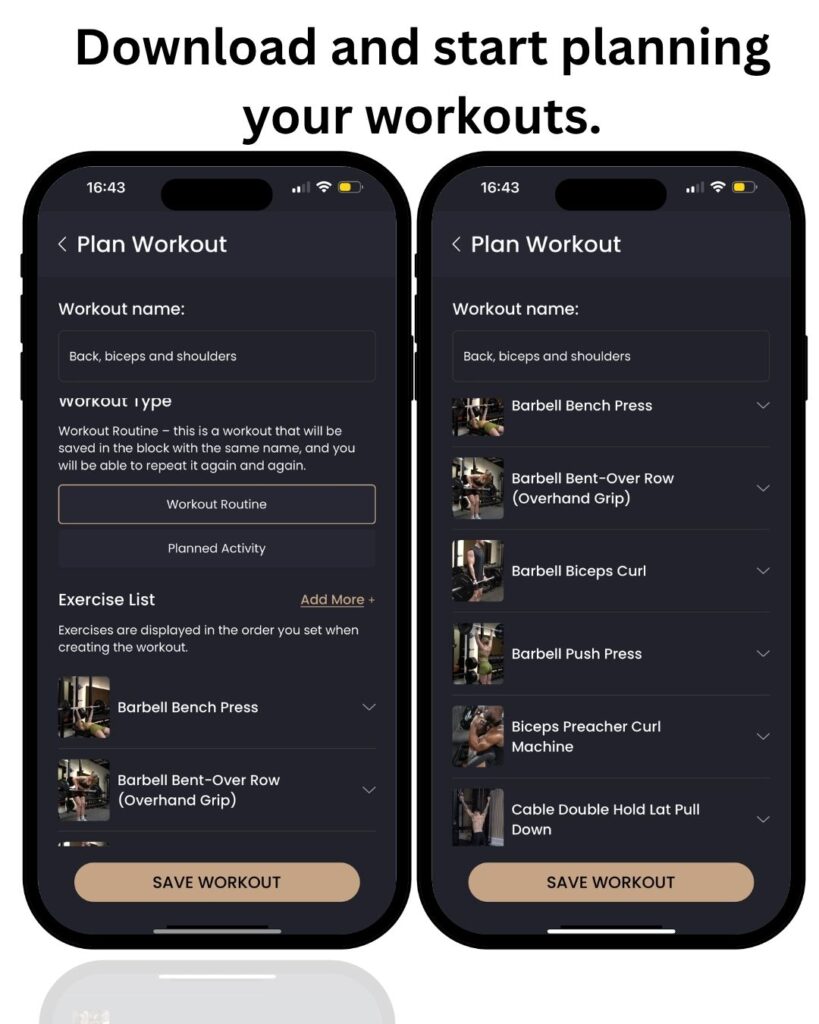
A proper gym workout planner tells you:
Exactly what exercises to perform that day Precisely how many sets and reps at what weight What rest periods to take between sets What to do next session based on today’s performance
The planning happens before you step in the gym. You’re not making decisions when you’re tired and unmotivated. You’re executing a strategy designed for systematic progress.
Client example: Tom trained randomly for 18 months, made minimal progress. We implemented structured planning—every session mapped out for 12 weeks based on push/pull/legs principles.
Six months later: 15kg added to his bench, 20kg to his squat, visible muscle development he’d never achieved in the previous 18 months of random training.
The difference? Having a plan.

Progressive Overload App: The Feature That Actually Matters
If I could only have one feature in a strength training app, it would be intelligent progressive overload management.
This is the most critical and most ignored feature in fitness apps.
Here’s what proper progressive overload implementation looks like:
Week 1-3: 60kg bench press, 3 sets of 8 reps Week 4: Hit 3 sets of 10 reps at 60kg? App recommends increasing to 62.5kg for Week 5 Week 5: Start 62.5kg at 3 sets of 8 reps, work back up to 10 reps Week 8-10: Hit 3 sets of 10 at 62.5kg? Increase to 65kg
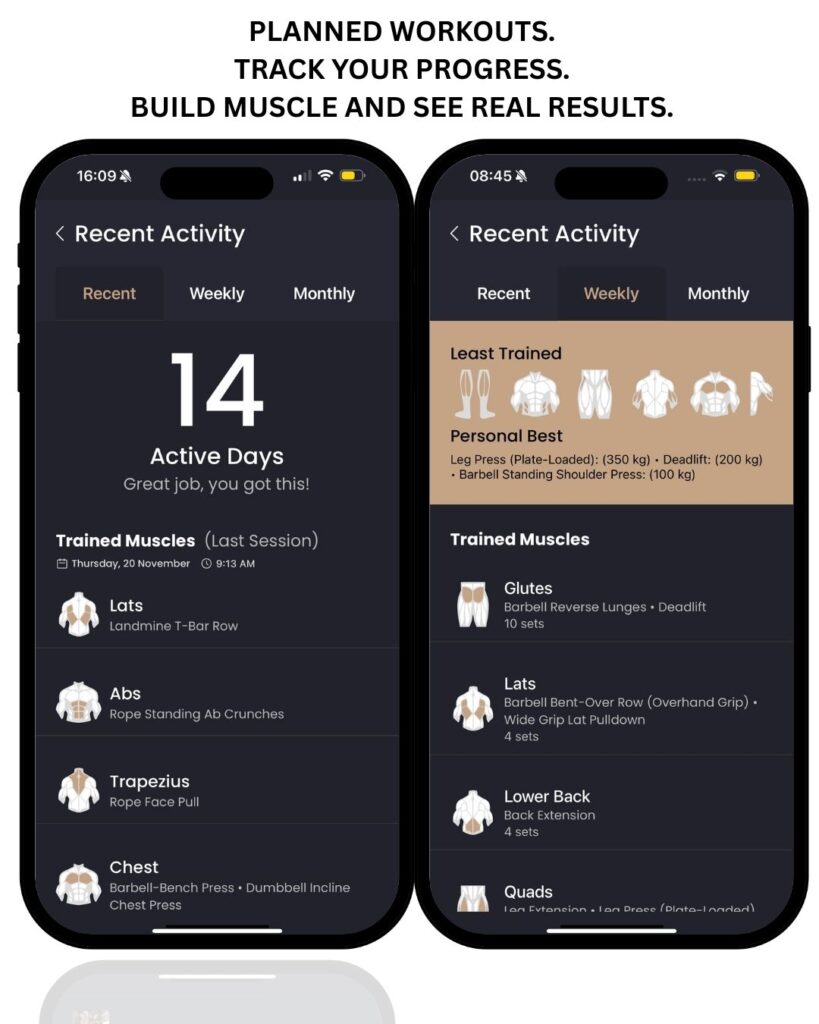
The app isn’t just tracking numbers. It’s telling you exactly when and how to progress based on your actual performance.
Without this, you’re guessing. “Should I add weight? Add reps? Add sets? Do something different?”
Guessing isn’t programming. Systematic progressive overload is programming.
This is built into every workout in the 12REPS app. You’re never wondering what to do next. The system tracks your performance and automatically suggests appropriate progression.
Best Female Strength App / Women Weightlifting App / Best Workout App for Women
The “best female strength app” or “women’s workout app” searches reveal a problem: most apps treat women as an afterthought.
They’ll take their standard programme, make it pink, reduce the weights, add some glute-focused exercises, and call it “designed for women.”
Lazy. Ineffective.
What women actually need:
Programming that accounts for hormonal fluctuations: Energy and recovery vary across menstrual cycles. Smart programming accounts for this.
Exercise modifications for common female anatomy: Hip structure affects squat mechanics. Shoulder width affects pressing positions. Good programmes adapt.
Realistic progression timelines: Women typically start with less upper body strength than men. The progression needs to accommodate this starting point whilst still pushing for improvement.
Community and support: Many women feel intimidated in gym environments. Apps with community features and supportive content help.
The strength training programmes for women in 12REPS aren’t just “men’s programmes made lighter.” They’re intelligently designed accounting for female physiology whilst maintaining the fundamental principles that produce results.
Build Muscle Lose Fat: The Programming Approach That Works
“I want to build muscle and lose fat.”
Most common goal. Also the most misunderstood.
Here’s reality: building muscle requires caloric surplus. Losing fat requires caloric deficit. You can’t optimally do both simultaneously unless you’re a complete beginner or returning from a long layoff.
But you can:
Prioritise one whilst maintaining the other: Build muscle in slight surplus whilst minimising fat gain, or lose fat in moderate deficit whilst preserving muscle
Use recomposition for beginners: The first 6-12 months of training, beginners can often build muscle whilst losing fat due to neural adaptations and “newbie gains”
Cycle between phases: 12-16 weeks building muscle in surplus, then 8-12 weeks cutting fat in deficit
The programming needs to match your current phase:
Building muscle: Higher volume, moderate to high frequency, progressive overload emphasis on adding weight
Losing fat: Moderate volume, maintain strength on key lifts, slight calorie deficit with high protein
A proper workout tracker app helps you navigate these phases by adjusting programming based on your current goal and performance feedback.
Why I Built 12REPS Differently
Every app I tested had the same fundamental flaw: they treated training like data entry instead of an adaptive system.
They’d track your workouts brilliantly. They’d graph your progress beautifully. But they wouldn’t actually tell you what to do differently when progress stalled.
So I built just12reps.com based on three principles:
Principle 1: Programming should be intelligent, not generic
Your workout today should be based on your performance last session, your available equipment, your recovery status, and your current goals. Not just “Day 15 of Programme X.”
Principle 2: Progression should be systematic, not guesswork
The app should tell you exactly when to add weight, add reps, or modify intensity. You shouldn’t be wondering if you’re progressing optimally.
Principle 3: Flexibility should be built-in, not an afterthought
Life isn’t consistent. Your training app needs to adapt to gym access, equipment availability, time constraints, and energy levels without destroying your progress.

The Bottom Line
Most workout tracker apps are spreadsheets with video demos. They track data but don’t actually make you stronger.
A proper strength training app should:
✅ Provide intelligent programming based on your context
✅ Implement progressive overload systematically
✅ Adapt to your equipment and schedule
✅ Include comprehensive exercise demonstrations
✅ Support your specific goals whether that’s building muscle, losing fat, or pure strength
The 12REPS app does all of this because I built it to solve the problems I saw clients struggling with daily.
Whether you’re completely new to training, an experienced lifter looking for better structure, a woman wanting effective strength programming, or someone who needs flexibility between home and gym training—proper programming makes the difference between months of spinning wheels and genuine progress.
Check out just12reps.com to see how intelligent programming and systematic progression can transform your training.
About Will Duru: BSc-qualified personal trainer with over 10 years experience training clients across London. Creator of the 12REPS app and specialist in evidence-based training methods. Available for in-person training and consultations.
Related Articles: