

What If Three Workouts a Week Were Enough?
What if three structured workouts per week were enough to help you become stronger, build muscle and take control of your training? For most adults in their 30s and 40s, that is not a rhetorical question. It is the realistic ceiling, and a three-day push-pull legs workout program is exactly the kind of structure that makes those three sessions count.
Random workouts tend to follow a familiar pattern. You repeat the same handful of exercises, miss entire muscle groups without realising it, and never quite know whether you are progressing or just turning up. Choosing exercises on the spot wastes time, training consistency suffers, and there is no clear way to measure whether week eight looks any different from week one.
None of that is a reflection of effort. It is simply what happens without a plan. A structured three-day split fixes the problem directly: it gives every session a purpose, spreads training across the week sensibly, and gives you a clear method for getting stronger over time, whether you train at home with dumbbells, kettlebells and bodyweight work, or in a commercial gym.

Why Three Workouts Per Week Can Work
A push-pull-and-legs split divides your training into three distinct sessions. Push day trains the chest, shoulders and triceps. Pull-day trains the back, rear shoulders, and biceps. Leg day trains the quadriceps, hamstrings, glutes and calves. Each session has a clear focus, which makes planning straightforward, whether you build your sessions inside the 12REPS strength training app or write them down yourself.
Three sessions a week works well for busy adults for several practical reasons: more recovery time between sessions, easier scheduling around work and family, clear coverage of every major muscle group, a shorter weekly time commitment than higher-frequency plans, simple progression from week to week, and the flexibility to train at home or in a gym without changing the structure.
The schedule matters less than the consistency. A sample week looks like this:
- Monday: Push
- Wednesday: Pull
- Friday: Legs
If that pattern does not suit your week, both of these work just as well:
- Tuesday, Thursday and Saturday
- Monday, Thursday and Saturday
Where possible, place at least one rest or active-recovery day between most sessions. The exact days matter far less than whether you can repeat the pattern reliably, week after week.

Why This Program Works for Your 30s
Your 30s are often the decade when work and family responsibilities expand quickly. A three-day program builds sustainable habits without demanding more time than you realistically have. It helps you maintain muscle and strength consistently, rather than swinging between intense bursts of training and long gaps, and it fits around real life instead of requiring you to rearrange your life around it.
Why This Program Works for Your 40s
In your 40s, recovery deserves a bit more respect, but that does not mean training has to become cautious or limited. This program allows enough recovery between sessions, manages training volume sensibly, and uses controlled technique rather than maximum-effort testing every week. You progress steadily, choose exercises that suit your body, and maintain both muscle and physical confidence without unnecessary risk.
Train With Total Clarity, Not Guesswork
Imagine starting each session already knowing exactly what to do: which workout is scheduled, which exercises to perform, how many sets and reps to use, how long to rest, and how to make the session harder once it starts feeling easier. That clarity is what removes the guesswork from training, and it is exactly what this program, paired with the 12REPS app, is designed to give you.

The Complete Eight-Week Program
The program is divided into four two-week phases. Each phase has a clear purpose, and progression happens gradually rather than all at once.
Weeks 1 and 2: Learn the Movements
Goal: practise technique, find suitable starting weights, and complete each session consistently.
- Perform two working sets per exercise
- Use the lower end of the repetition range
- Finish each set with two to four repetitions left in reserve
- Avoid training to failure
- Record every set in the 12REPS app
Weeks 3 and 4: Build Training Volume
Goal: add more quality work, improve exercise confidence, and begin progressing repetitions.
- Increase most exercises to three working sets
- Keep the same weight where needed
- Add one or two repetitions when the technique remains controlled
- Finish most sets with two or three repetitions left in reserve
Weeks 5 and 6: Progressive Overload
Goal: increase resistance or exercise difficulty and continue improving performance.
- Add a small amount of weight once the top of the repetition range is reached
- Bodyweight users can use slower repetitions, pauses or harder variations
- Keep three working sets for most exercises
- Finish most sets with one to three repetitions left in reserve
Weeks 7 and 8: Consolidate and Progress
Goal: complete the strongest controlled version of the program, review progress, and prepare for the next training block.
- Keep the same exercises that remain effective
- Improve weight, repetitions, control or range of motion
- Do not change every exercise
- Avoid testing one-repetition maximums
- Compare week eight with week one
Quick tip: Save these three workouts in the 12REPS app before week one, so every session is ready to log the moment you start training.
Workout One: Push
Push day trains the chest, shoulders and triceps across six movements. Choose one version, dumbbell, kettlebell or bodyweight, for each exercise rather than performing every variation.
Exercise | Dumbbell | Kettlebell | Bodyweight | Sets x Reps | Rest |
1. Horizontal press | DB bench or floor press | KB floor press | Push-up / elevated push-up | 2-3 x 8-12* | 90-150s |
2. Vertical press | DB shoulder press | Single-arm KB press | Pike push-up | 2-3 x 8-12 | 90-120s |
3. Upper-chest movement | Incline DB press | KB bridge press | Feet-elevated push-up | 2-3 x 8-12 | 90-120s |
4. Lateral shoulder movement | DB lateral raise | Light KB lateral raise | Wall lateral isometric / pike tap | 2-3 x 10-15 | 45-75s |
5. Triceps movement | DB overhead extension | KB overhead extension | Close-grip push-up | 2-3 x 8-12 | 60-90s |
6. Core movement | DB dead bug | KB dead bug hold | Dead bug / plank | 2-3 x 30-45s | 45-60s |
*Progress sets and reps through the four phases as described above: 2 sets at the lower range in weeks 1-2, building to 3 sets with more reps and resistance by weeks 7-8.
Workout Two: Pull
Pull-day trains the back, rear shoulders, and biceps. For the vertical pull in a gym, the cable machine lat pulldown, an assisted pull-up or a full pull-up all work well. At home, bodyweight vertical pulling normally requires a secure pull-up bar; without one, a dumbbell or kettlebell pullover, or a controlled reverse snow angel, is a safer substitute than an unsecured furniture setup.
Exercise | Dumbbell | Kettlebell | Bodyweight | Sets x Reps | Rest |
1. Horizontal row | One-arm DB row | One-arm KB row | Inverted row (secure setup) | 2-3 x 8-12 | 90-120s |
2. Vertical pull | DB pullover | KB pullover | Pull-up bar pull-up / reverse snow angel | 2-3 x 6-12 | 90-150s |
3. Hip hinge | DB Romanian deadlift | KB Romanian deadlift | Single-leg hip hinge | 2-3 x 8-12 | 90-120s |
4. Rear-shoulder movement | DB reverse fly | Light KB reverse fly | Reverse snow angel | 2-3 x 10-15 | 45-75s |
5. Biceps movement | DB curl | KB curl | Self-resisted curl | 2-3 x 8-12 | 60-90s |
6. Carry or posture exercise | Farmer’s carry | Suitcase carry | Bear crawl / plank shoulder tap | 2-3 x 20-40m | 60-90s |
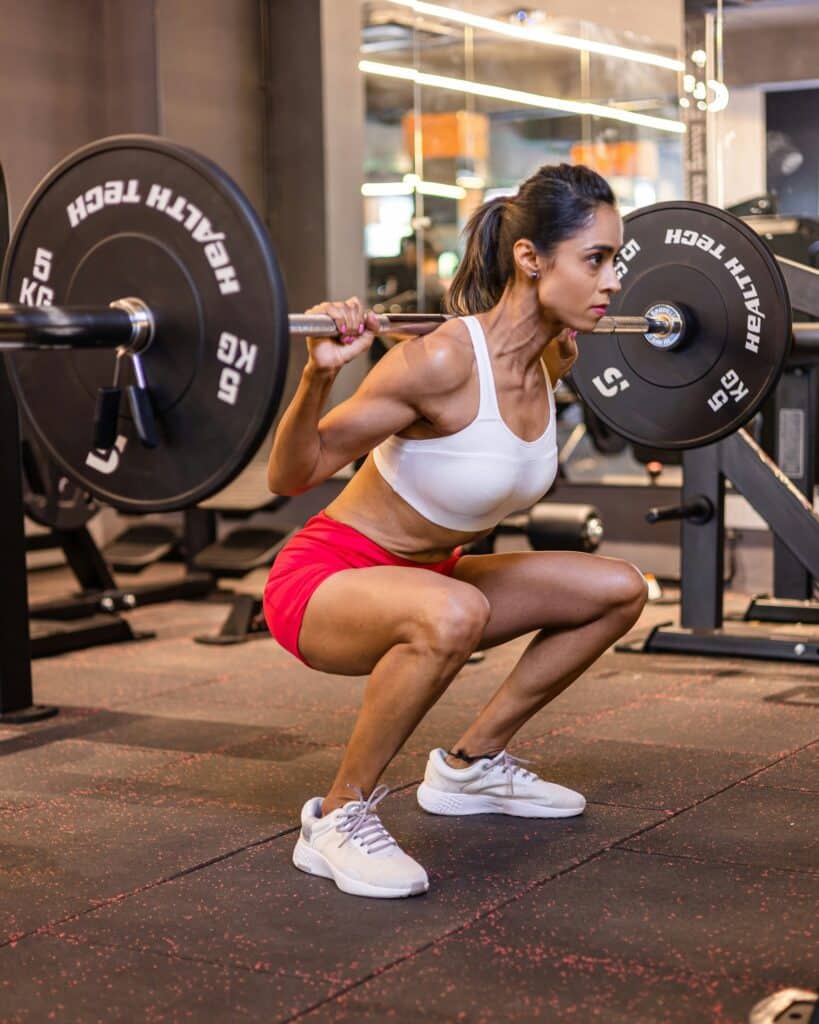
Workout Three: Legs
Leg day trains the quadriceps, hamstrings, glutes and calves across six movements, covering squatting, single-leg work, hip hinging and direct glute and calf training.
Exercise | Dumbbell | Kettlebell | Bodyweight | Sets x Reps | Rest |
1. Squat pattern | DB goblet squat | KB goblet squat | Bodyweight / tempo squat | 2-3 x 8-12 | 90-150s |
2. Single-leg movement | DB reverse lunge | KB reverse lunge | Reverse lunge / split squat | 2-3 x 8-12 each side | 75-120s |
3. Hip hinge | DB Romanian deadlift | KB Romanian deadlift | Single-leg Romanian deadlift | 2-3 x 8-12 | 90-120s |
4. Glute movement | DB hip thrust | KB glute bridge | Glute bridge / single-leg bridge | 2-3 x 10-15 | 60-90s |
5. Hamstring movement | DB-assisted leg curl (suitable equipment) | KB Romanian deadlift variation | Sliding leg curl (suitable surface) | 2-3 x 8-12 | 60-90s |
6. Calf and core finisher | Weighted calf raise | Suitcase carry | Single-leg calf raise / side plank | 2-3 x 12-20 | 45-60s |
Equipment-Based Exercise Swaps
Use this table to confirm your equipment choice for each movement pattern. Pick one column per exercise, not every option in the same session.
Movement pattern | Dumbbell option | Kettlebell option | Bodyweight option |
Horizontal press | Bench or floor press | Floor press | Push-up |
Vertical press | Shoulder press | Single-arm press | Pike push-up |
Horizontal pull | One-arm row | One-arm row | Inverted row |
Vertical pull | Pullover | Pullover | Pull-up / reverse snow angel |
Squat | Goblet squat | Goblet squat | Bodyweight squat |
Lunge | Reverse lunge | Reverse lunge | Reverse lunge / split squat |
Hip hinge | Romanian deadlift | Romanian deadlift | Single-leg hinge |
Glute extension | Hip thrust | Glute bridge | Glute bridge |
Biceps | Curl | Curl | Self-resisted curl |
Triceps | Overhead extension | Overhead extension | Close-grip push-up |
Core | Dead bug | Dead bug hold | Plank / dead bug |
Carry | Farmer’s carry | Suitcase carry | Bear crawl |

Home Workout Setup
At home, you can complete the full program with one or two dumbbells, one or two kettlebells, your bodyweight, a stable bench where available, a training mat, and a secure pull-up bar where available.
When your weights are limited, you still have several ways to progress:
- Add repetitions
- Slow the lowering phase
- Add a pause at the hardest point
- Increase range of motion
- Use unilateral, single-sided exercises
- Reduce assistance
- Use a harder bodyweight variation
Avoid adding speed at the expense of control. A slower, well-controlled repetition is more effective than a fast, sloppy one.
Gym Workout Setup
In a commercial gym, you can replace the home versions of each exercise with the bench press, chest press machine, cable row, lat pulldown, leg press, leg curl, cable triceps pushdown, or cable biceps curl. Machines are valid training tools, not inferior substitutes for free weights. Choose whichever version you can perform consistently and comfortably, since the exercise you can repeat reliably will always outperform the one you avoid.
How to Choose Your Starting Weight
Your starting weight should allow you to complete the target repetitions with controlled form. A simple way to judge this is repetitions in reserve: at the end of most sets, you should feel that you could perform another two or three controlled repetitions if you had to. If you are unsure, begin with bodyweight or a lighter load and increase resistance once your technique feels solid.

Progression Rules for the Eight Weeks
This program uses double progression, a simple and reliable method for increasing repetitions before increasing weight:
- Start at the lower end of the repetition range
- Add repetitions across future sessions
- Reach the top of the range with good technique
- Increase the weight by the smallest practical amount
- Return to the lower end of the range
- Repeat the process
For example:
- Week one: 10kg for 8, 8 and 8 repetitions
- Week two: 10kg for 9, 8 and 8
- Week three: 10kg for 10, 9 and 8
- Week four: 10kg for 12, 11 and 10
- Next progression: increase the weight and return to 8 repetitions
Progress will not always increase every single week, and that is normal. Looking at the trend across two to three weeks matters more than judging any one session in isolation.
Rest and Recovery
- Rest 90 to 180 seconds after demanding compound exercises
- Rest 45 to 90 seconds after smaller, single-joint exercises
- Sleep as consistently as your schedule allows
- Eat enough protein to support training and recovery
- Schedule recovery days rather than treating them as optional
- Walk or do light activity between sessions
- Reduce volume on weeks where recovery feels poor

Supporting Weight Loss With the Program
This program can support weight loss by helping you maintain or build muscle, increasing your weekly activity, and giving you a repeatable routine that improves training consistency and supports body-composition goals over time. It is important to be clear that the program does not directly guarantee fat loss. Fat loss requires a sustainable calorie deficit; the training itself supports that process rather than replacing it.
Find Every Exercise in the 12REPS Library
Every movement in this program, and its dumbbell, kettlebell and bodyweight alternatives, can be searched in the 12REPS strength training exercise library. You can search by muscle group, filter by equipment, find dumbbell or kettlebell exercises specifically, or look up bodyweight-only options when you are training without equipment.
Each entry includes a video demonstration and the main muscles trained, so if a specific piece of equipment is not available on a given day, you can quickly find a suitable replacement without breaking your routine.
How the 12REPS App Helps You Follow the Program
The 12REPS strength training app is where this programme becomes practical to follow day to day. You can save all three workouts, record every set, repetition and weight, review your previous session before you start the next one, and track personal bests as they happen.
If an exercise is not available on a given day, the app’s filters help you find a suitable replacement instantly, so you can follow the eight-week progression described above without relying on memory or paper notes.
A Programme Built on Real Coaching Experience
This programme was designed by PT Will, a personal trainer with a BSc (Hons) in Sport and Exercise Science. The structure gives you a clear framework to follow, while the dumbbell, kettlebell and bodyweight options let you match the exercises to your own equipment, experience and training environment.
Common Mistakes to Avoid
- Starting with weights that are too heavy
- Adding too many exercises to a single session
- Training every set to failure
- Changing the programme every week
- Skipping the leg session
- Using poor technique to complete more repetitions
- Failing to record workouts
- Progressing too quickly
- Ignoring persistent pain
- Treating sweating as the main measure of workout quality
- Eating without considering the training goal
- Comparing your progress with other people’s
Start Your Three-Day Push Pull Legs Programme
None of this guarantees a specific outcome. Results depend on training consistency, nutrition, recovery, sleep and individual circumstances, and progress will look different from one person to the next. What this programme offers is structure: a clear three-day push pull legs workout programme you can actually stick to.
Choose a Monday, Wednesday and Friday schedule, or another three-day pattern that fits your week. Select a dumbbell, kettlebell or bodyweight version of each exercise. Record your starting repetitions and weights, follow the programme for eight weeks, and review your progress before changing the plan.
You do not need six gym sessions or a complicated routine. Explore the 12REPS strength training app, build your three-day programme and track every workout for the next eight weeks.

No comment yet, add your voice below!