

You’ve had your baby. Your body has changed, your routine has gone, and you’re probably tired in a way you didn’t know was possible.
You may also want to feel strong again. Maybe you want your core back, or your energy. Maybe you just want to pick up your baby without your back aching.
I’m Will Duru, a personal trainer who works with clients in Central London, including SW1. I’m not a mum, so I won’t pretend to know how this feels. What I do know is training. I’ve worked in fitness for over 12 years, and I hold a BSc (Hons) in Sport and Exercise Science from London South Bank University. I’ve spent time reading the research on getting back to exercise after birth. Here’s what it says, and how I’d approach it with you.
What your body has just been through
Pregnancy and birth ask a lot of your body, however your baby arrived.
Your abdominal muscles stretch to make room. Your pelvic floor carries extra load for months. Your posture shifts. Your lower back and core may be weaker than before, and your ligaments and joints stay more supple for months, which makes it easier to strain something by stretching or twisting too far.
None of this means something has gone wrong. It means you need a sensible plan. Rushing back to your old routine is where most problems start.
When can you start?
The honest answer is that it depends on you, your birth and your recovery.
After a straightforward birth, the NHS says you can begin gentle exercise as soon as you feel up to it, and it suggests getting advice at your 6-week check before high-impact exercise such as running. Gentle means walking, pelvic floor exercises and basic deep abdominal work. A walk through St James’s Park with the pram counts.
If you had a caesarean, your recovery will take longer, so speak to your midwife, health visitor or GP before doing anything strenuous.
Here’s how the physiotherapy guidance maps it out. In the first two weeks the focus is pelvic floor strength, basic core work such as pelvic tilts, and walking. Squats, lunges and bridges can come in at weeks two to four. Around weeks six to eight, you can add deadlifts and resistance for your legs and core. That’s the framework many physios use, and I follow the same logic.
Running comes later. The widely quoted guidance says to build pelvic floor and core strength first, and to start running no earlier than 12 weeks, and only if you have no pelvic floor symptoms. One detail matters. The authors recommend that every mum is offered a pelvic health assessment from six weeks with a specialist physiotherapist, whatever the type of birth. If you can book one, I’d encourage it.
I’m not replacing your midwife, GP or physio. I work alongside them.

Core strength after pregnancy: what the evidence says
This is the question I hear most. “Will my stomach ever feel normal again?”
Many mums have a gap between the two sides of the abdominal wall, called diastasis recti. It’s very common. One review reports it affects around half of women at 4 to 6 weeks after delivery, falling to about 39% by six months. It isn’t a failure on your part.
So does exercise close it? The honest answer is that the research is still limited. A systematic review of eight studies and 336 women found the evidence was too weak to say whether non-specific exercise prevents or reduces the gap. That’s a small and dated evidence base. A smaller trial looked more promising. In a randomised trial of 40 postpartum women, an eight-week deep core stability program reduced the separation.
What I take from this:
- Exercise is safe and useful, but nobody can promise a particular result.
- Deep core work and pelvic floor training come first, before heavy loading.
- Sit-ups and crunches are not where I’d start.
- Strength, function and symptoms matter more than the size of the gap.
My aim is a core that works well when you lift, carry and move. You’ll feel stable, not held in.
Why strength training matters, not just "getting your body back"
I’d like to move away from the idea of bouncing back. Your goal is to get strong.
The UK Chief Medical Officers advise at least 150 minutes of moderate activity a week after childbirth, pelvic floor exercises daily, and building back up to muscle-strengthening activities twice a week. They also note that it’s safe to be active and you can do so while breastfeeding.
Strength training fits this well. It builds the muscle you use every day, from carrying a car seat to lifting a pushchair up steps. It supports your back and posture. And for many mums, it brings back a sense of control.
Your mood matters too. About 1 in 10 women become depressed in the year after having a baby, and gentle exercise can help lift your mood. Exercise won’t fix everything. If you feel low, anxious or overwhelmed, please talk to your GP or health visitor. That’s not weakness.
Weight loss may come, but I’d keep it in the background. Sleep, stress and feeding all affect your body. Results vary from person to person.
What training with me looks like
We start with a conversation, not a workout.
I ask about your birth, your recovery, any advice from your midwife or physio, your sleep, and what you want. Then I build a programme around you.
Here’s the rough shape, though your pace is your own.
Phase one: rebuild the foundation. Breathing, pelvic floor work, deep core and gentle movement. Short sessions, low load.
Phase two: build strength. Squats, hinges, rows, presses and carries. If you’re returning to an exercise you did before, start with lighter weights than you used before and build up gradually. That’s how I’d do it anyway.
Phase three: progress and perform. Heavier lifting, more demanding core work, and impact only when you’re ready and symptom-free.
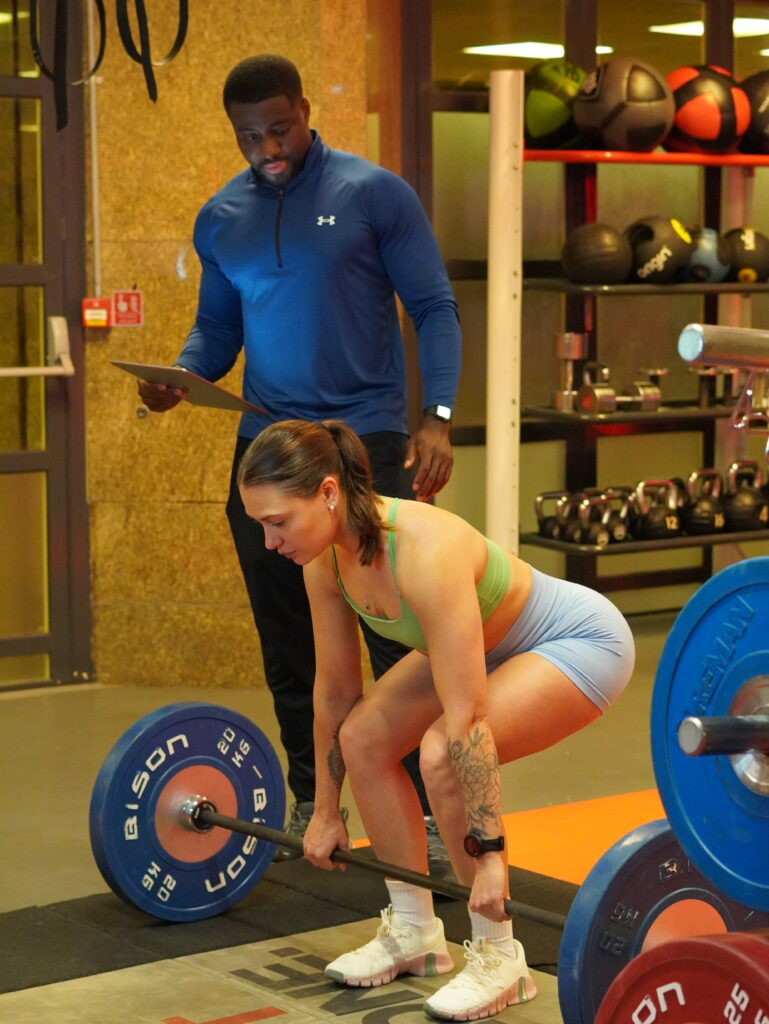
Sessions are one-to-one, so I can watch your technique and adjust on the spot. If something doesn’t feel right, we change it. No questions.
Ready to talk it through? Enquire about a first session and we’ll see what suits you.


No comment yet, add your voice below!