

If you sit at a desk all day, the most useful thing you can do is strength train twice a week and break up your sitting during the day. You don’t need a special “desk worker” routine. You need a plan that works your upper back, hips and legs, the muscles a long day in a chair leaves with very little to do, and a few habits that get you up and moving between meetings.
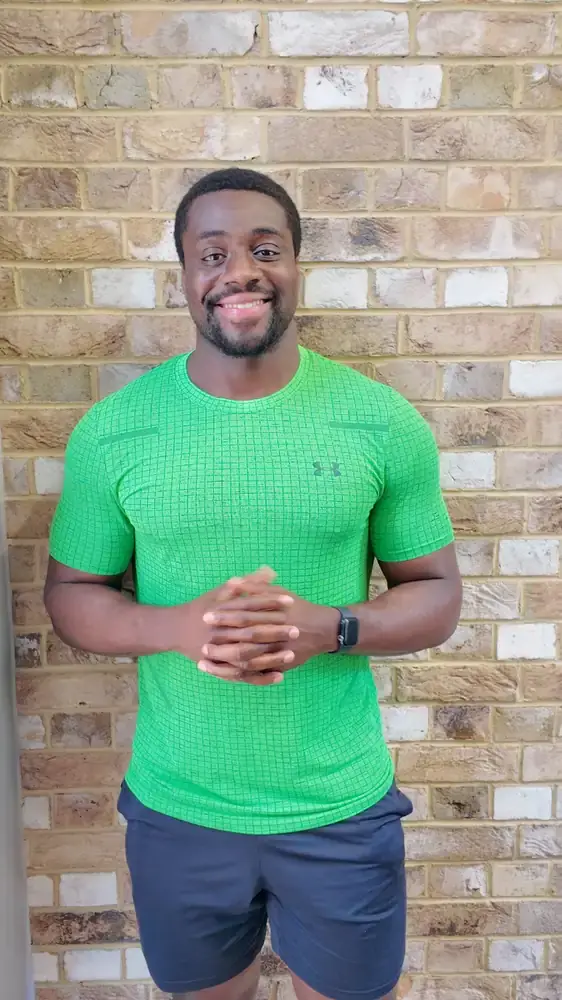
I’m Will Duru, a personal trainer in SW1 with over 12 years’ experience and a BSc (Hons) in Sport and Exercise Science. Many of my clients work long days in offices around Westminster, Victoria and St James’s. This is how I train them.
What a day at a desk does, and doesn’t, mean
Sitting for long hours is linked to worse long-term health. The encouraging part is how much activity helps. A large 2016 analysis of data from more than a million adults found that 60 to 75 minutes a day of moderate activity, such as brisk walking, was enough to remove the extra risk of early death linked to sitting for more than eight hours a day (Ekelund et al., 2016). That’s a study of associations, not a guarantee, but the message is clear: moving more matters.
The UK Chief Medical Officers also say that cutting down on time spent sitting, especially for long stretches, brings extra health benefits even if you’re already active (UK CMO physical activity guidelines). So training twice a week helps, and so does how you spend the rest of your day.

Many of my clients also tell me they feel stiff in the hips and upper back after a long day. Strength training won’t magically change how you sit, and I won’t promise it fixes your posture. What it does is make the muscles you rarely use at a desk stronger and more used to working, and most people feel better for it.
Move more during the working day
Government guidance on getting adults active suggests taking regular time not sitting during work and breaking up long journeys by walking part of the way (Health Matters, UK Government). In practice, that looks like:
- Get up between meetings. Stand, walk to refill your water, or take the stairs to the next floor.
- Walk your calls. If you don’t need your screen, take the call on your feet.
- Walk part of the commute. Get off a stop early, or cut through St James’s Park on the way in.
- Use lunch. Even a short walk outside beats another half hour in the chair.

None of this replaces training. It fills the gaps between sessions.
The muscles I focus on for desk workers
- Upper back. Rows and face pulls, such as the single-arm dumbbell row and rope face pull. A desk day leaves these muscles with little to do.
- Glutes and hips. Hip hinges and single-leg work, such as the dumbbell Romanian deadlift and Bulgarian split squat. Sitting keeps your hips bent for hours, so we train them to work through a full range.
- Legs. A squat pattern, such as the goblet squat, for overall leg strength.
- Core. Exercises that teach you to keep your trunk steady while your arms and legs move, using the same breathing and bracing I teach for heavier lifts.
- Chest and shoulders. Pressing still matters, such as the incline dumbbell press. I usually balance it with at least as much pulling.
A simple two-session week
Here’s the kind of week I’d start a desk-based client on. Each session begins with a short warm-up.
Session A
- Goblet squat
- Single-arm dumbbell row
- Incline dumbbell press
- Rope face pull
- A core exercise to finish
Session B
- Dumbbell Romanian deadlift
- Bulgarian split squat
- A second row variation
- A carry, walking with a weight in each hand
- A core exercise to finish
Leave at least a day between sessions. As you get stronger, we add weight or reps gradually through progressive overload. If your diary is already full, my guide for busy professionals shows how to keep training through a heavy week.

What if you already have back or neck pain?
Speak to your GP or a physio first, especially if the pain is new, severe or getting worse, or comes with numbness, pins and needles or weakness. I’m not a physio and I don’t diagnose or treat pain. Once you’ve been checked, I’m happy to work alongside your physio and build training around their advice.
How I train desk workers in SW1
Most of my desk-based clients train early, before the working day takes over. I coach one-to-one at your home or building gym across SW1, or at my private studio in Fitzrovia (W1T 3DN). When you travel for work, we can keep going with online sessions from a hotel gym.
Train with me
If you spend most of your day at a desk and want a plan that fits around it, this is what I do.
- 10 sessions: £1,900 (£190 per session)
- 50 sessions: £8,500 (£170 per session)
Sign up for a package and you also get a year’s free access to the 12REPS app, so you can log your workouts between sessions.
Book a free consultation and tell me about your working week and what you’d like to change.
Prefer to talk first? WhatsApp me using the WhatsApp icon in the bottom-right corner of the screen, or email connect@ptwill.com.
Will Duru, BSc (Hons) Sport and Exercise Science, personal trainer with over 12 years’ experience.

